

Those Vaccinated Spreading Measles: WHO, Merck, CDC Documents Confirmed
- By Sayer Ji - Friday, January 30th, 2015
20 years ago, the MMR vaccine was found to infect virtually all of its recipients with measles. The manufacturer Merck's own product warning links MMR to a potentially fatal form of brain inflammation caused by measles. Why is this evidence not being reported?
The phenomenon of measles infection spread by MMR (live measles-mumps-rubella vaccine) has been known for decades. In fact, 20 years ago, scientists working at the CDC's National Center for Infectious Diseases, funded by the WHO and the National Vaccine Program, discovered something truly disturbing about the MMR vaccine: it leads to detectable measles infection in the vast majority of those who receive it.
Published in 1995 in the Journal of Clinical Microbiology and titled, "Detection of Measles Virus RNA in Urine Specimens from Vaccine Recipients," researchers analyzed urine samples from newly MMR vaccinated 15-month-old children and young adults and reported their eye-opening results as following:
- Measles virus RNA was detected in 10 of 12 children during the 2-week sampling period.
- In some cases, measles virus RNA was detected as early as 1 day or as late as 14 days after the children were vaccinated.
- Measles virus RNA was also detected in the urine samples from all four of the young adults between 1 and 13 days after vaccination.
The authors of this study used a relatively new technology at that time, namely, reverse transcriptase polymerase chain reaction (RT-PCR), which they believed could help resolve growing challenges associated with measles detection in the shifting post-mass immunization epidemiological and clinical landscape. These challenges include:
- A changing clinical presentation towards 'milder' or asymptomatic measles in previously vaccinated individuals.
- A changing epidemiological distribution of measles (a shift toward children younger than 15 months, teenagers, and young adults)
- Increasing difficulty distinguishing measles-like symptoms (exanthema) caused by a range of other pathogens from those caused by measles virus.
- An increase in sporadic measles outbreaks in previously vaccinated individuals.
Twenty years later, PCR testing is widely acknowledged as highly sensitive and specific, and the only efficient way to distinguish vaccine-strain and wild-type measles infection, as their clinical presentation are indistinguishable.
Did the CDC Use PCR Testing On The Disneyland Measles Cases?
The latest measles outbreak at Disney is a perfect example of where PCR testing could be used to ascertain the true origins of the outbreak. The a priori assumption that the non-vaccinated are carriers and transmitters of a disease the vaccinated are immune to has not been scientifically validated. Since vaccine strain measles has almost entirely supplanted wild-type, communally acquired measles, it is statistically unlikely that PCR tests will reveal the media's hysterical storyline -- "non-vaxxers brought back an eradicated disease!" -- to be true. Until such studies are performed and exposed, we will never know for certain.
Laura Hayes, of Age of Autism, recently addressed this key question in her insightful article "Disney, Measles, and the Fantasyland of Vaccine Perfection":
"Has there been any laboratory confirmation of even one case of the supposed measles related to Disneyland? If yes, was the confirmed case tested to determine whether it was wild-type measles or vaccine-strain measles? If not, why not? These are important questions to ask. Is it measles or not? If yes, what kind, because if it's vaccine-strain measles, then that means it is the vaccinated who are contagious and spreading measles resulting in what the media likes to label "outbreaks" to create panic (a panic more appropriately triggered by our 25 year history of epidemic autism).
It would be what one might call vaccine fallout. People who receive live-virus vaccines, such as the MMR, can then shed that live virus, for up to many weeks and can infect others. Other live-virus vaccines include the nasal flu vaccine, shingles vaccine, rotavirus vaccine, chicken pox vaccine, and yellow fever vaccine."
Additional Evidence That the Vaccinated Are Not Immune, Spread Disease
The National Vaccine Information Center has published an important document relevant to this topic titled "The Emerging Risks of Live Virus & Virus Vectored Vaccines: Vaccine Strain Virus Infection, Shedding & Transmission." Pages 34-36 in the section on "Measles, Mumps, Rubella Viruses and Live Attenuated Measles, Mumps, Rubella Viruses" discuss evidence that the MMR vaccine can lead to measles infection and transmission.
Cases highlighted include:
- In 2010, Eurosurveillance published a report about excretion of vaccine strain measles virus in urine and pharyngeal secretions of a Croatian child with vaccine-associated rash illness.[1] A healthy 14-month old child was given MMR vaccine and eight days later developed macular rash and fever. Lab testing of throat and urine samples between two and four weeks after vaccination tested positive for vaccine strain measles virus. Authors of the report pointed out that when children experience a fever and rash after MMR vaccination, only molecular lab testing can determine whether the symptoms are due to vaccine strain measles virus infection. They stated: "According to WHO guidelines for measles and rubella elimination, routine discrimination between aetiologies of febrile rash disease is done by virus detection. However, in a patient recently MMR-vaccinated, only molecular techniques can differentiate between wild type measles or rubella infection or vaccine-associated disease. This case report demonstrates that excretion of Schwartz measles virus occurs in vaccinees."
- In 2012, Pediatric Child Health published a report describing a healthy 15-month old child in Canada, who developed irritability, fever, cough, conjunctivitis and rash within seven days of an MMR shot.[2] Blood, urine and throat swab tests were positive for vaccine strain measles virus infection 12 days after vaccination. Addressing the potential for measles vaccine strain virus transmission to others, the authors stated, "While the attenuated virus can be detected in clinical specimens following immunization, it is understood that administration of the MMR vaccine to immunocompetent individuals does not carry the risk of secondary transmission to susceptible hosts.
- In 2013, Eurosurveillance published a report of vaccine strain measles occurring weeks after MMR vaccination in Canada. Authors stated, "We describe a case of measlesmumps-rubella (MMR) vaccine-associated measles illness that was positive by both PCR and IgM, five weeks after administration of the MMR vaccine." The case involved a two-year-old child, who developed runny nose, fever, cough, macular rash and conjunctivitis after vaccination and tested positive for vaccine strain measles virus infection in throat swab and blood tests.[3] Canadian health officials authoring the report raised the question of whether there are unidentified cases of vaccine strain measles infections and the need to know more about how long measles vaccine strain shedding lasts. They concluded that the case they reported "likely represents the existence of additional, but unidentified, exceptions to the typical timeframe for measles vaccine virus shedding and illness." They added that "further investigation is needed on the upper limit of measles vaccine virus shedding based on increased sensitivity of the RT-PCR-based detection technologies and immunological factors associated with vaccine-associated measles illness and virus shedding." In addition to this evidence for the disease-promoting nature of the measles vaccine, we recently reported on a case of a twice vaccinated adult in NYC becoming infected with measles and then spreading it to two secondary contacts, both of which were vaccinated twice and found to have presumably protective IgM antibodies.
This double failure of the MMR vaccine renders highly suspicious the unsubstantiated claims that when an outbreak of measles occurs the non- or minimally vaccinated are responsible. The assumption that vaccination equals bona fide immunity has never been supported by the evidence itself. We have previously reported on a growing body of evidence that even when a vaccine is mandated, and 99% of a population receive the measles vaccines, outbreaks not only happen, but as compliance increases vaccine resistance sporadic outbreaks also increase -- a clear indication of vaccine failure.
There is also the concerning fact that according to the MMR vaccine's manufacturer Merck's own product insert, the MMR can cause measles inclusion body encephalitis (MIBE), a rare but potentially lethal form of brain infection with measles. For more information you can review a case report on MIBE caused by vaccine strain measles published in the journal Clinical Infectious Diseases in 1999 titled "Measles inclusion-body encephalitis caused by the vaccine strain of measles virus."
Global Measles Vaccine Failures Increasingly Reported
China is not the only country dealing with outbreaks in near universally vaccinated populations. Between 2008-2011, France reported over 20,000 cases of measles, with adolescents and young adults accounting for more than half of cases.[4] Remarkably, these outbreaks began when France was experiencing some of their highest coverage rates in history. For instance, in 2008, the MMR1 coverage reached 96.6% in children 11 years of age. For a more extensive review of measles outbreaks in vaccinated populations read our article The 2013 Measles Outbreak: A Failing Vaccine, Not A Failure to Vaccinate.
Given that clinical evidence, case reports, epidemiological studies, and even the vaccine manufacturer's own product warnings, all show directly or indirectly that MMR can spread measles infection, how can we continue to stand by and let the media, government and medical establishment blame the non-vaccinated on these outbreaks without any concrete evidence?
References:
[1] Kaic B, Gjenero-Margan I, Aleraj B. Spotlight on Measles 2010: Excretion of Vaccine Strain Measles Virus in Urine and Pharyngeal Secretions of a Child with Vaccine Associated Febrile Rash Illness, Croatia, March 2010. Eurosurveillance 2010 15(35).
[2] Nestibo L, Lee BE, Fonesca K et al. Differentiating the wild from the attenuated during a measles outbreak. Paediatr Child Health Apr. 2012; 17(4).
[3] Murti M, Krajden M, Petric M et al. Case of Vaccine Associated Measles Five Weeks Post-Immunisation, British Columbia, Canada, October 2013. Eurosurveillance Dec. 5, 2013; 18(49).
[4] Antona D, Lévy-Bruhl D, Baudon C, Freymuth F, Lamy M, Maine C, Floret D, Parent du Chatelet I. Measles elimination efforts and 2008-2011 outbreak, France. Emerg Infect Dis. 2013 Mar;19(3):357-64. doi: 10.3201/eid1903.121360. PubMed PMID: 23618523; PubMed Central PMCID: PMC3647670. Free full text Related citations
Agency will confiscate infant if entire family doesn’t get flu vaccine shots
A foster mom takes a stand against medical mandates imposed on her family.
- By Police State USA - January 14, 2015

TACOMA, WA — A state bureaucracy is threatening a mother with removal of an infant unless her entire family subjects themselves to flu shots.
This is the dilemma that foster parent Jamie Smith is currently facing. The Washington Department of Social and Health Services (DSHS) is giving the Tacoma family until February to comply with the mandated regimen of influenza vaccines — imposed on every member of the family — or else they will lose their youngest child, a 2-week-old foster infant that was born on Christmas.
Mrs. Smith is a dedicated foster mom, and has fostered seven babies. She currently raises five children, including an adopted 4-year-old daughter. Her objection to vaccines is based on safety concerns for her family, she revealed in an interview with KOMO News:
“I’ve done a lot of research on it and I don’t like some of the side effects that it has,” she said.
Smith says she’s worried about mercury in the vaccine and its effects on the brain. She doesn’t want her or her five children exposed to that even if it means losing the little one.
“I’ve thought about that a lot,” said Smith. “Unfortunately, I have to think about our kids who are in the house first and to me they’re more important, their safety, than trying to fight to keep this little guy.”
Among the alarming vaccine ingredients that Mrs. Smith referred to is Thimerosal, a drug stabilizer that contains the compound ethyl mercury, a known neurotoxin. Popular influenza vaccines such as Fluzone®, FluLaval®, and Fluvirin® each contain Thimerosal.
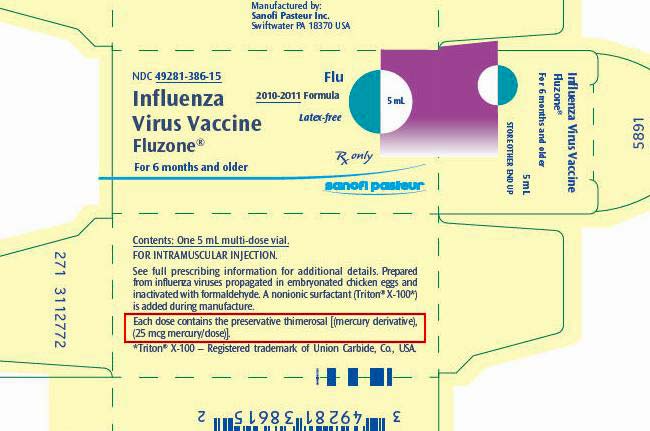
Flu shots, like the ones listed above, are responsible for a host of neurological disorders and other serious side effects. According to the DOJ’s report on the National Vaccine Injury Compensation Program — which settles vaccine injury claims since the drug makers were made legally blameless by Congress — over half the compensatory claims handled between 5/16/2013 to 8/15/2013 were for adverse reactions to flu vaccines. The injuries included:
Guillain-Barré Syndrome, myelopathy and radiculopathy; psoriasis and psoriatic arthritis; chronic inflammatory demyelinating polyneuropathy; skin rash, fatigue, and scarring; brachial neuritis; shoulder injury related to vaccine administration, autoimmune demyelinating condition, bursitis, Bell’s palsy and urticaria/angioedema; bilateral brachial neuritis; meningoencephalitis and optic neuritis; transverse myelitis, serum sickness and pain amplification syndrome of childhood/fibromyalgia; acute disseminated encephalomyelitis; rheumatoid arthritis; significant aggravation of an underlying COPD and other pulmonary conditions, and death.
Despite these weighty concerns, Mrs. Smith’s informed objection to vaccinating is being cast aside by bureaucratic force. The mandate holds that she, her husband, and each of the other children must be injected with the drug, or else their family will be broken apart and their precious “Christmas baby” will be taken away.
“I’m hoping that we can raise enough of a voice that the state will at least give waivers or do something so the children won’t be taken out of their homes,” Mrs. Smith told KOMO News. Her family’s integrity requires that readers and supporters rally against these invasive medical mandates imposed on families like the Smiths.
ACCOUNTABILITY CHECK
Call and write Demand that Washington State Department of Social and Human Services back down and leave families alone regarding their choice to avoid harmful vaccines.
Washington State Department of Social and Human Services
Phone: 1-800-737-0617
Website: https://www.dshs.wa.gov/ca/about-childrens-administration
Facebook: http://www.facebook.com/WaStateDSHS
Jennifer Strus, Assistant Secretary
This email address is being protected from spambots. You need JavaScript enabled to view it.
The Shocking Harmful Ingredients In Beer
- By Vani Hari - Food Babe
I have to confess, I’m not a beer drinker, but there’s someone in my household that loves it, so I had to figure out the truth. Is beer really healthy? Why are the ingredients not listed on the label? Which brands can we trust? Which brands are trying to slowly poison us with cheap and harmful ingredients? All of these questions were going through my head at once at lightning speed. So a year ago, I started to research what was really in beer and after questioning several beer companies, reading books about food science, and talking to experts, the information I discovered was downright shocking.
I see it all the time. Someone who eats organic, makes the right choices at the grocery store, is fit and lives an extraordinarily healthy lifestyle but then drinks beer like it is going out of style.
Caring about what you eat doesn’t necessarily translate into caring about what you drink and this is a HUGE MISTAKE.
Before we get into what exactly is in beer that you should be worried about, let’s talk about how body reacts to alcohol in general.
Alcohol is metabolized by the body differently than all other calories you consume. Alcohol is one of the only substances that you consume that can permeate your digestive system and go straight into your bloodstream. It bypasses normal digestion and is absorbed into the body intact, where it goes straight into the liver.
Your liver is your main fat-burning organ. If you are trying to lose weight or even maintain your ideal weight, drinking alcohol is one of your worst enemies. The liver is going to metabolize alcohol first vs. the fat you want to get rid of – making weight loss even harder. Additionally, one of the primary functions of the liver is to remove environmental toxins from your body – if it is overtaxed with alcohol, the normal removal of these toxins becomes extremely diminished and can result in rapid aging, loss of libido, and other diseases.
The one thing that has gotten me before and I’m sure many of you – is the health marketing claims on alcohol products making drinking them seem like a good idea and an added “benefit” to your health. The low alcohol content of beer makes it appear as an innocuous beverage and something people throw back without even thinking about it. Who hasn’t seen those studies that say a beer a day is great for you (I want to ask who ever stops at just one beer?)?
So, inherently, alcohol by itself is not a healthy person’s best friend – but that’s just the tip of the iceberg. Beer, especially American beer, is made with all sorts of ingredients beyond the basic hops, malt and yeast. There are numerous other ingredients used to clarify, stabilize, preserve, enhance the color and flavor of beer.
When you drink beer, there is almost a 100% chance that you don’t know what you are drinking (unless you quizzed the beer companies like I did). The ingredients in beer are not required by law to be listed anywhere on the label and manufacturers have no legal obligation to disclose the ingredients. For regular beer, calorie levels and percent alcohol are optional and for light beer calories are mandatory but alcohol levels are optional.
Michele Simon, a public health lawyer, author of Appetite for Profit, and president of Eat Drink Politics told me the reason that beer companies don’t disclose ingredients is simple: they don’t have to.
“Ingredient labeling on food products and non-alcoholic beverages is required by the Food and Drug Administration. But a whole other federal agency regulates beer, and not very well. The Department of Treasury – the same folks who collect your taxes – oversees alcoholic beverages. That probably explains why we know more about what’s in a can of Coke than a can of Bud. You can also thank the alcohol industry, which has lobbied for years against efforts to require ingredient labeling.”
I figured if the beer companies aren’t required to tell us the exact list of ingredients, I needed to investigate this for myself and asked them the pointed questions until I got the truth.
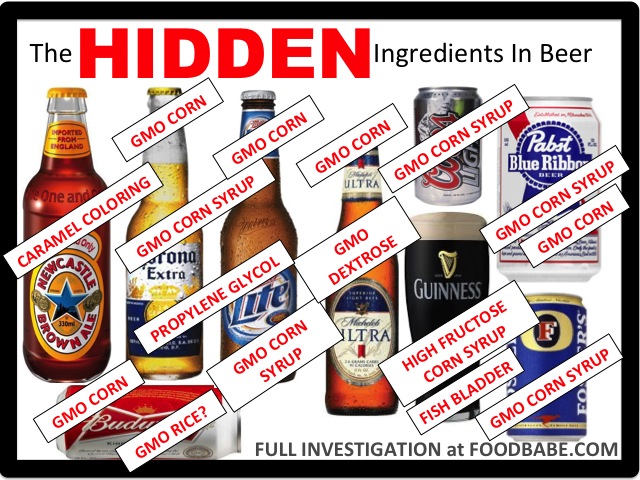
First of all, I was able to obtain a baseline list of “legal” additives allowed in beer from the book “Chemicals Additives in Beer” by the Center of Science and Public Interest. This list allowed me to ask specific questions about each beer I investigated. For example – beer sold here in America can contain several of the following ingredients:
-
Monosodium Glutamate (MSG) – alcohol is already addictive with some people, but with MSG?! Holy smokes.
-
Propylene Glycol (an ingredient found in anti-freeze)
-
Calcium Disodium EDTA (made from formaldehyde, sodium cayanide, and Ethylenediamine)
-
Many different types of sulfites and anti-microbial preservatives (linked to allergies and asthma)
-
Natural Flavors (can come from anything natural including a beavers anal gland)
-
High Fructose Corn Syrup
-
GMO Sugars – Dextrose, Corn Syrup
-
Caramel Coloring (Class III or IV made from ammonia and classified as a carcinogen)
-
FD&C Blue 1 (Made from petroleum, linked to allergies, asthma and hyperactivity)
-
FD&C Red 40 (Made from petroleum, linked to allergies, asthma and hyperactivity)
-
FD&C Yellow 5 (Made from petroleum, linked to allergies, asthma and hyperactivity)
-
Insect-Based Dyes: carmine derived from cochineal insects to color their beer.
-
Animal Based Clarifiers: Findings include isinglass (dried fish bladder), gelatin (from skin, connective tissue, and bones), and casein (found in milk)
-
Foam Control: Used for head retention; (glyceryl monostearate and pepsin are both potentially derived from animals)
-
BPA (Bisphenol A is a component in many can liners and it may leach into the beer. BPA can mimic the female hormone estrogen and may affect sperm count, and other organ functions.)
-
Carrageenan (linked to inflammation in digestive system, IBS and considered a carcinogen in some circumstances)
During my investigation, I couldn’t get a single mainstream beer company to share the full list of ingredients contained in their beer. But I did get some of them to fess up to the use of these ingredients in writing so I’m going to share this information with you now.
Carcinogenic Caramel Coloring
Newcastle, a UK brand, confessed to using what I would consider one of the most controversial food additives. Toasted barley is usually what gives beer its golden or deep brown color, however in this case, Newcastle beer is also colored artificially with caramel color. This caramel coloring is manufactured by heating ammonia and sulfites under high pressure, which creating carcinogenic compounds. If beer companies were required by law to list the ingredients, Newcastle would likely have to have a cancer warning label under California law because it is a carcinogen proven to cause liver tumors, lung tumors, and thyroid tumors in rats and mice.
Genetically Modified Organisms (GMOs)
Many of the beers I questioned contained one or more possible GMO ingredients.
- High Fructose Corn Syrup (Guinness – unable to provide an affidavit for non-GMO proof)
- Corn syrup (Miller Light, Coors, Corona, Fosters, Pabst Blue Ribbon, Red Stripe)
- Dextrose (Budweiser, Bud Light, Busch Light, Michelob Ultra)
- Corn (Red Stripe, Miller Coors Brand, Anheuser-Busch Brands)
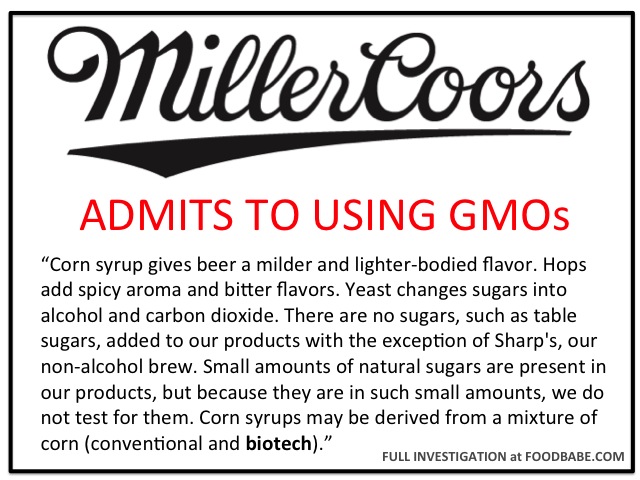
Most beers brewed commercially are made with more GMO corn than barley. Many of the companies I contacted dodged the GMO question – however Miller Coors had a very forthcoming and honest response. They stated “Corn syrup gives beer a milder and lighter-bodied flavor” and “Corn syrups may be derived from a mixture of corn (conventional and biotech.)”, admitting their use of GMOs.
Pabst Blue Ribbon responded saying their corn syrup was “special” and “made of carbohydrates and some simple sugars like dextrose and maltose. The sugars are fermented into alcohol and CO2, and the carbohydrates, both from the corn syrup and the malt, remain in the beers as flavor, color and body components.”
Dextrose and maltose can come from a variety of substances that are sweet, but likely are derived from GMO corn because it is super cheap for a company to use corn instead of fruit or other non-GMO sources. With cheap beer – you are not just getting a cheap buzz, you are getting the worst of the worst. Just like with cheap fast food – if you don’t invest in your beer – you will be drinking a lower quality product like Pabst Blue Ribbon that is made from GMO Corn and Corn Syrup.
In 2007, Greenpeace found unapproved and experimental GMO Rice strain in Anheuser-Busch (Budweiser, Bud Light) beer. Anheuser-Busch responded saying their US-grown long-grained rice “may have micro levels” of a genetically engineered protein called Liberty Link, but added that the protein is “substantially removed or destroyed” during the brewing of beer sold domestically. Don’t you think it’s hard to trust any beer company that gets caught using experimental food made in a laboratory? GMOs have not been tested long term on human beings and one of the main pesticides (Roundup) they spray on GMO crops are linked to inflammation, cancer and other diseases.
High Fructose Corn Syrup & Fish Bladders
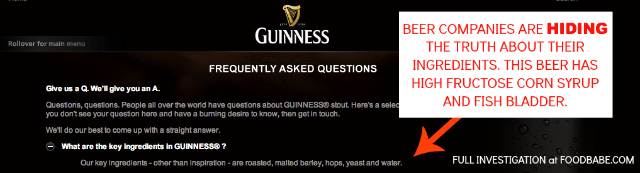
Speaking of trusting companies, let’s get one thing straight, Guinness beer is no longer owned by the Irish, they are now owned by a large beer conglomerate called Diageo and manufactured in over 50 different countries. No matter how many St. Patty’s Day celebrations you’ve had with this dark stout, it’s time to stop because they use high fructose corn syrup in their beer (4/2/14 Update: Guinness Beer claims they do not use high fructose corn syrup any longer, but refuses to disclose ingredient affidavits or full of list of ingredients.) But, Guinness beer also contains isinglass, a gelatin-like substance produced from the swim bladder of a fish. This ingredient helps remove any “haziness,” solids, or yeast byproducts from the beer. Mmmmm… fish bladder sounds delicious, doesn’t? The sneaky thing this beer company does like many of the companies mentioned here today is create an illusion of using the best ingredients when in actuality what they tell you publicly on their websites is a complete farce. On Guinness FAQ’s – they have a question that states: “What are the key ingredients in Guinness” and the answer doesn’t reveal the whole picture – it only states “Our key ingredients – other than inspiration – are roasted, malted barley, hops, yeast and water.” What BS, right? You have to call, email, question and know the right things to ask to even have a chance at getting the truth. This is insanity.
So What Beers Are Additive and GMO Free?
If you enjoy the occasional beer and wish to maintain your healthy lifestyle, choosing one without GMOs and additives is ideal. Unfortunately, most of the mainstream beers available have additives, but luckily, there are a few that don’t. For example, Sierra Nevada, Heineken, and Amstel Light (7/31/13 UPDATE: It has come to my attention that Heinken USA has changed their formula to use GMOs – I called their customer service line 1-914-681-4100 to confirm and asked for the list of ingredients – the man told me “water, yeast, malted barley and hops” – then I asked if their beer contained any genetically engineered material and he confirmed “YES,” but wouldn’t tell me what ingredients are genetically engineered. They recently changed their formula after my initial research that started in late 2012.) (8/1/13 Update: Heineken reached out to me personally to say their customer service department made an error in telling me and others who called their beer has GMOs. I met with a head brew master and have viewed affidavits from the company and confirmed Heinken and Amstel Light do not contain GMOs – they apologize for the confusion.) appear to be pretty clean (but these companies still wouldn’t disclose the full list of ingredients to me. They did say they use non-GMO grains, no artificial ingredients, stabilizers or preservatives).
German Beers are also a good bet. The Germans are very serious about the purity of their beers and enacted a purity law called “Reinheitsgebot” that requires all German beers to be only produced with a core ingredient list of water, hops, yeast, malted barley or wheat. Advocates of German beers insist that they taste cleaner and some even claim they don’t suffer from hangovers as a result.
An obvious choice to consider is also Certified Organic Beers. They are required by law to not include GMOs and other harmful additives. Organic beers also support environmental friendly practices and reduce the amount of pesticides and toxins in our air, support organic farmers – which is a huge plus. (To this day, the beer drinkers in my family haven’t found one they love so if you have suggestions, please let us know in the comments!)
Craft & Microbrews Beers – For certain local craft and micro beers, you can ask those companies for a list of ingredients and many of them will be up front with you. However, companies like Miller Coors are slowly closing in on craft beers and buying them up one by one… like they did when they created the unique popular variety called Blue Moon (the beer you drink with an orange) and Anhesuer-Busch did this with Rolling Rock and Goose Island Brewery. Make sure your favorite craft and microbrew is still independently owned and controlled before taking a sip.
In the end – if you decide to drink beer, you are definitely drinking at your own risk for more reasons than just the crazy ingredients that could be in them. The key point to remember is – if you like to drink beer and want to be healthy, drink it infrequently and quiz the beer companies for the truth. Find a beer that you can trust and stick with it.
For your reference, here are some important questions to ask your favorite beer company:
-
What are the ingredients in your beer – all of them from start to finish?
-
Are any of your ingredients GMO?
-
Do you use any soy, corn, or rice processing ingredients? (Examples include: dextrose, corn syrup, etc.)
-
Do you add any natural, artificial flavors or colors to the beer? (Examples include: yellow #5, caramel coloring, red #40, MSG, natural flavors)
-
Are there any additional preservatives, stabilizers and/or clarifying agents added to your beer during processing? (Examples include: propylene glycol, Calcium Disodium EDTA, anything ending in “sulfite” like sodium metabisulfite, Heptylparaben, isinglass)
If you know someone who drinks beer – share this post with them.
These ingredients are no joke. We must inform and protect each other from these industrial chemicals, untested and potentially harmful ingredients and it starts by sharing your knowledge with the ones you love.
5 Ingredients That Should Have Never Been Approved By The FDA – Are You Eating Them?
- By Vani Hari - Food Babe - January 9, 2015
 The more I learn about the food system, the more passion grows inside me to change it. What I am about to share with you will have you gasping for air – it’s so downright appalling. There’s a sorry state of affairs regarding the approval of new food ingredients in this country, and there is a BIG misconception that the FDA diligently reviews and approves them all.
The media has reported some serious mistakes made by the FDA in the recent past, like approving a tea that contained cocaine to be sold in the U.S. and approving a new pain killer that their own advisory committee voted against. While these actions are very telling, I’m focusing here on what the media hasn’t been talking about. A glimpse into the last few decades of FDA oversight shows how little the FDA has done to improve the food system in this country, how they have allowed us to eat harmful food additives and fail to act (sometimes for years) after an ingredient has been found to be unsafe.
There are several products that have been deemed “FDA Approved” or “Generally Recognized As Safe” which were yanked from market years after they were shown to be downright dangerous. What’s really scary about this is that history shows that something very serious needs to happen – like deaths – before the FDA takes action. Does someone really need to die before an ingredient is banned? In the eyes of the FDA, that may be the case. I thought I’d put together a few examples for you of ingredients that have been allowed into our food supply, despite ample research showing that they’re harmful. The fact that these are (or have been) allowed in our food is outrageous, as there are safer ingredients and practices that could be used by the industry.
1 - Sulfites on Fresh Vegetables
REGULATORY STATUS: Approved in 1982 / Banned in 1986
The FDA approved sulfite preservatives on fresh produce in 1982, despite evidence that sulfites could trigger asthma attacks. Soon after, many people got sick and some even died after eating salads laced with sulfites in restaurants. The Center for Science in the Public Interest (CSPI) claimed to have documented over a dozen deaths, and petitioned the FDA to ban its use - yet the FDA failed to act for 4 long years. The FDA finally banned sulfites on fresh produce in 1986 and subsequently limited it in other foods.
2 - Artificial Coloring Red No. 3 - Erythrosine
REGULATORY STATUS: Banned from Cosmetics in 1990 / Still Approved in Food
After finding out that Red #3 causes cancer in animal studies the FDA banned it from cosmetics in 1990. Yet, the FDA still permits Red #3 in our food and you’ll find it in chewing gum, Nesquik Strawberry Milk, popsicles, yogurts, fruit cocktail, Duff’s cake mix, Betty Crocker icing and candy – but you won’t find it legally in lipstick. In 1989, the Washington Post reported that the fruit industry was “enraged” by the FDA’s proposal to ban Red #3 from food, because “Americans like their cherries red” in a can. So they lobbied the House Appropriations Committee to add language to “its report on the FDA’s funding for next year that instructed the FDA not to ban the dye-formally titled FD&C red No. 3-without further study.” This is in violation of the “Delaney Clause” that requires the FDA to ban carcinogenic food ingredients. When they banned it in cosmetics, the FDA said it would “take steps” to ban in it food too. Well, it’s been over 20 years, and we are still waiting for the FDA to take action on Red #3. There are six more artificial food colors that were approved for food and later banned by the FDA: Green 1, Green 2, Red 1, Red 2, Red 4, and Violet 1.
3 - Partially Hydrogenated Oils / Artificial Trans Fat
REGULATORY STATUS: GRAS Tentatively Withdrawn 2013 / Still Permitted in Food
Partially hydrogenated oils are everywhere at the grocery store, especially in the bakery aisle (pies, crackers, cakes, cookies) and in fried foods at restaurants. When partially-hydrogenated oils are manufactured they create artificial trans fats. In the 1990s, research came out that showed trans fat raises the “bad” LDL cholesterol, and lowers the “good” HDL cholesterol, increasing the risk of heart disease. According to the CDC, up to 7,000 deaths and 20,000 heart attacks per year can be attributed to artificial trans fat in the diet – and it’s been shown to be the most harmful fat in our food – yet, the FDA still allows it. After decades of mounting research, the FDA finally made a tentative determination that partially hydrogenated oils are no longer considered GRAS in November 2013 – but that doesn’t mean it’s been taken out of our food. The FDA has still not made a final determination to ban it, despite pleas from the American Heart Association and the American College of Cardiology. Food manufacturers see the writing on the wall and many of them are voluntarily removing partially hydrogenated oils from their products. Beware that even if a product is labeled “0 grams of Trans Fat” it’s permitted to contain up to .5 grams of trans fat per serving, and this is why it’s still very important to check the ingredient list for partially hydrogenated oils to make sure it’s clean of artificial trans fat.
4 - Caramel Coloring Level IV
REGULATORY STATUS: Approved in Food / Currently Under Review & “Assessing Consumer Exposure”
Caramel coloring has been deemed “Generally Recognized As Safe” (GRAS) by the FDA and is the most widely used food coloring in the world. Although it sounds harmless, Level IV caramel color contains the cancer-causing byproduct 4-methylimidazole (4-Mel). In 2007, research was published that showed 4-Mel was carcinogenic. Consumer’s Reports tested the levels of 4-Mel in drinks and found it in excessive levels in several soft drinks that contain caramel color. They petitioned the FDA to limit and label its use, however the FDA has not taken this action. The FDA simply released a statement that they would review its safety and “determine what, if any, regulatory action needs to be taken”. Following their presentation at the American Chemical Society Annual Meeting in August 2014, the FDA said they have no reason to believe that current caramel coloring levels are a concern, so it looks like the FDA has no plans to limit, label or ban it. There are 4 levels (types) of caramel coloring and they are only listed on ingredient list as “caramel color” – the type (like Level IV) is not generally disclosed. Given that this coloring is in so many processed foods (sometimes in levels exceeding “safe” standards), it’s difficult to avoid. No one is assessing the cumulative consumption of caramel color from all of these sources. We are still waiting for Starbucks to remove caramel coloring from their drinks in the U.S., especially since they don’t use it in other countries (proving that it’s unnecessary!)
5 - Antibiotics in Animal Feed for Growth Promotion
REGULATORY STATUS: Approved in Animal Feed / Voluntary Guidance to Industry Issued in 2013
The meat industry uses significantly more antibiotics than the healthcare industry and it’s been reported that animals receive 80% of the antibiotics produced in this country (estimated at 29 million pounds per year). The real reason that industrial farms are systematically feeding their animals antibiotics is to produce bigger animals that grow faster on less food – thereby increasing their profits – and also to help the animals survive the poor conditions they are being raised in. Do you see anything wrong with this picture? The CDC does, and warns that this use is contributing to antibiotic-resistant infections in humans and harming public health. Recent reports indicate that antibiotic resistance can be blamed for at least 2 million illnesses and 23,000 deaths in the U.S. and Dr. Thomas R. Frieden, Director of the CDC is warning, “If we don’t act now, our medicine cabinet will be empty and we won’t have the antibiotics we need to save lives” - a scary prospect. In 2013, the FDA issued guidance for the industry (that goes into effect in December 2016), which recommends halting the use of antibiotics to fatten up animals, along with veterinary oversight of antibiotic use. The FDA’s guidance is voluntary and not legally enforceable:
“FDA’s guidance documents, including this guidance, do not establish legally enforceable responsibilities. Instead, guidances describe the FDA’s current thinking on a topic and should be viewed only as recommendations, unless specific regulatory or statutory requirements are cited. The use of the word “should” in FDA’s guidances means that something is suggested or recommended, but not required.“
According to Pew Charitable Trusts, there’s a huge loophole that will still permit antibiotics for “disease prevention” in “the absence of any threat from a specific bacterial disease”, which may allow veterinarians to rationalize a prescription for routine antibiotics. Reuters reported,
“by enlisting the help of veterinarians…the FDA will be empowering a profession that not only has allegiances to animals, farmers and public health, but also has pervasive and undisclosed financial ties to the makers of the drugs… No laws or regulations – including the new FDA directives – require veterinarians to reveal financial connections to drug companies. That means veterinarians can be wined and dined and given scholarships, awards, stipends, gifts and trips by pharmaceutical benefactors without the knowledge of the FDA or the public.”
The European Union took a stronger stand and banned antibiotics in animal feed for growth promotion in 2006 (nearly 10 years ago!) and “animal food production in these countries continues to thrive, with appropriate adjustments in practices to ensure continued animal health and safety”. Meanwhile in the U.S., the FDA is setting weak voluntary standards that don’t hold much weight.
What To Do With This Information:
Even if the FDA does nothing to rid our food supply of these dangerous ingredients, there is an easy way to protect yourself. Organic standards prohibit these ingredients mentioned here, so one of the best ways to avoid harmful ingredients is to choose 100% certified organic food and to prepare your own meals at home with minimally processed ingredients. Beware that organic standards still allow some ingredients with known health risks, like carrageenan. So, you still need to read those ingredient lists and make informed decisions about your food! I realize that this can be a challenge. That’s why I created an Eating Guide that makes meal planning, food shopping, and cooking as effortless as possible. My new book The Food Babe Way will give you a 21-day plan to put you on the right path to navigating this screwed up food system!
Please spread the word, the more people that know the truth, the faster this food system will change!
- You are here:
-
Home

- Health