

Protect Yourself From Digital Utility Smart Meters
Do not sucker for costly "Opt-Out" programs. IT'S EXTORTION..! Utility companies have blind-sided their customers with digital meters that are harmful, dangerous, invasive and unlawful. Here are some ways for utility customers to protect themselves. More solutions are available at FreedomTaker.Com
More information and resources at the following pages
http://burbankaction.wordpress.com/category/by-kiku-lani-iwata/
http://stopsmartmeters.org/
http://www.thermoguy.com/emfeducation.html
If you expect to post comments here about how great it is that the power companies are radiating and conducting surveillance on private properties without disclosure and consent, expect your comments to be removed. This is not censorship, it is responsible management of false information. You can always post that on your own page.
Futurist: Smart Meters Will Know What TV Show You are Watching
'Internet of Things' could have "catastrophic consequences"

- By Paul Joseph Watson - February 12, 2015
Global security futurist Marc Goodman warns that smart meters may one day be able to detect what television programs people are watching, another example of how the ‘Internet of Things’ threatens to jeopardize privacy.
Goodman, who has previously worked as an adviser to the FBI, the US Secret Service and Interpol, told Singularity Hub’s Jason Dorrier that the widespread implementation of the ‘Internet of Things’ could lead to “catastrophic consequences,” such as cars being remotely hacked and made to crash.
“Twenty years ago nobody worried about their car being hacked,” said Goodman. “Today, a typical car uses over 250 microchips that can be hacked remotely. Somebody can remotely deploy your airbag or slam on the brakes as you’re going down the highway.”
The futurist also warned that the arrival of the ‘smart home’ would lead to a cornucopia of new surveillance opportunities, echoing former CIA director David Petraeus, who hailed the “Internet of things” as a transformational boon for “clandestine tradecraft” in a 2012 Wired Magazine interview.
Smart meters, for example, are now being installed around the world. Every single device you plug into an electric socket has its own signature. When you plug in your Samsung television or Hamilton blender, the outlet knows what is being plugged into it. And from that you can derive even further intelligence.
There are startups now that are looking at the fluctuations in energy usage to deduce what pixels are highlighted on your television, and by knowing what pixels are highlighted on the TV, they can reverse engineer, based upon the electricity that you use, what television programs you’re watching.
The European Data Protection Supervisor (EDPS) cautions that the rollout of smart meters will allow “massive collection of personal data” by utility companies and governments, tracking what “households do within the privacy of their own homes, whether they are away on holiday or at work, if someone uses a specific medical device or a baby monitor, or how they spend their free time”.
The idea of the government or hackers vacuuming up information via people’s televisions has been a hot topic this week, with Samsung being forced to respond to revelations that its Smart TVs are sending private conversations to a third party Internet server.
As Infowars first reported back in November, Samsung’s global privacy policy advises users to, “Please be aware that if your spoken words include personal or other sensitive information, that information will be among the data captured and transmitted to a third party through your use of Voice Recognition.”
After the mainstream media picked up the story three months later, Samsung was forced to admit that words heard by the device’s microphone were being “sent to a server” run by a third party, although the company said the communications were encrypted.
The Dark Side of 'Smart' Meters
November 01, 2010 - In this invitational presentation to the San Francisco Tesla Society consulting engineer Rob States explains how PG&E's so-called 'smart' meters work and why they endanger health and privacy. He asks the obvious question, "Why would you trust the company that brought you Prop. 16?"
What is in Those Supplements?

- By Anahad O'Connor - February 3, 2015 - The New York Times
The New York State attorney general’s office accused four national retailers on Monday of selling dietary supplements that were fraudulent and in many cases contaminated with unlisted ingredients.
The authorities said they had run tests on popular store brands of herbal supplements at the retailers — Walmart, Walgreens, Target and GNC — which showed that roughly four out of five of the products contained none of the herbs listed on their labels. In many cases, the authorities said, the supplements contained little more than cheap fillers like rice and house plants, or substances that could be hazardous to people with food allergies.
At GNC, for example, the agency found that five out of six samples from the company’s signature “Herbal Plus” brand of supplements “were either unrecognizable or a substance other than what they claimed to be.” In pills labeled ginkgo biloba, the agency found only rice, asparagus and spruce, an ornamental plant commonly used for Christmas decorations.
At Target, the agency tested six herbal products from its popular “Up and Up” store brand of supplements. Three out of six – including ginkgo biloba, St. John’s wort and valerian root, a sleep aid – tested negative for the herbs listed on their labels. But the agency did find that the pills contained powdered rice, beans, peas and wild carrots.
Here are the products that were analyzed by the attorney general, along with the test results that were described in cease-and-desist letters that the agency sent to the four retailers. Meanwhile we, the consumers should boycott: Walmart, Walgreens, Target and GNC.
From GNC, Herbal Plus brand:
Gingko Biloba:
- No gingko biloba found
- Did detect allium (garlic), rice, spruce and asparagus
St. John’s Wort
- No St. John’s Wort found
- Did detect allium (garlic), rice and dracaena (a tropical houseplant)
Ginseng
- No ginseng found
- Did detect rice, dracaena, pine, wheat/grass and citrus
Garlic
- Contained garlic
Echinacea
- No echinacea found
- Did detect rice in some samples
Saw Palmetto
- One sample contained the clear presence of palmetto
- Other samples contained a variety of ingredients, including asparagus, rice and primrose
From Target, Up & Up brand
Gingko Biloba
- No gingko biloba found
- Found garlic, rice and mung/French bean
St. John’s Wort
- No St. John’s Wort found
- Found garlic, rice and dracaena (houseplant)
Garlic
- Contained garlic
- One test identified no DNA
Echinacea
- Most but not all tests detected Echinacea
- One test identified rice
Saw Palmetto
- Most tests detected saw palmetto
- Some tests found no plant DNA
Valerian Root
- No valerian root found
- Found allium, bean, asparagus, pea family, rice, wild carrot and saw palmetto
From Walgreens, Finest Nutrition brand
Gingko Biloba
- No gingko biloba found
- Did detect rice
St. John’s Wort
- No St. John’s Wort found
- Detected garlic, rice and dracaena
Ginseng
- No ginseng found
- Detected garlic and rice
Garlic
- No garlic found
- Detected palm, dracaena, wheat and rice
Echinacea
- No echinacea found
- Identified garlic, rice and daisy
Saw Palmetto
- Contained saw palmetto
From Walmart, Spring Valley brand
Gingko Biloba
- No gingko biloba found
- Found rice, dracaena, mustard, wheat and radish
St. John’s Wort
- No St. John’s Wort found
- Detected garlic, rice and cassava
Ginseng
- No ginseng found
- Found rice, dracaena, pine, wheat/grass and citrus
Garlic
- One sample showed small amounts of garlic
- Found rice, pine, palm, dracaena and wheat
Echinacea
- No echinacea or plant material found
Saw Palmetto
- Some samples contained small amounts of saw palmetto
- Also found garlic and rice
Related: “New York Attorney General Targets Supplements at Major Retailers”
Related: “Letters Outlining What Was Found in Herbal Supplements”
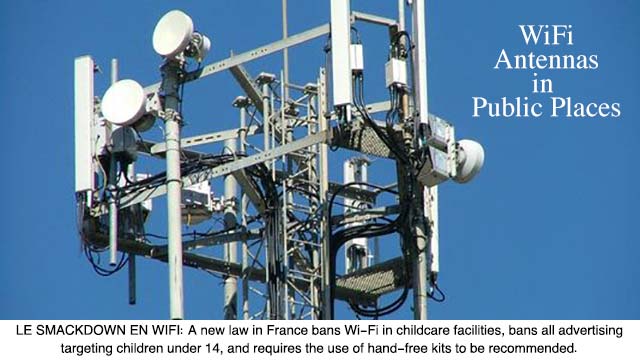
France law bans Wi-Fi in daycares, restricts wireless infrastructure
- By Pierre Le Hir - Le Monde, France - February 1, 2015
Two years in the works, a new law governing public exposure to electromagnetic fields generated by wireless technology (including base stations, mobile phones, tablets, and WiFi) was adopted by the Members of the National Assembly (MNAs) on Thursday, January 29. It was passed by a majority vote, while the UDI Party abstained – except Bertrand Pancher (Meuse), who voted in favor. The UMP voted against it, seeing it as an barrier to the development of digital industries.
This new law – the first in France to establish a precautionary approach addressing the potential health risks of radio frequencies – is the result of a real obstacle course, during which its initial ambitions were seriously downgraded. The Bill, filed in January 2013 by the MNA for Val-de-Marne Laurence Abeille (Europe Ecologie-Greens) had been referred to committee by the Socialists, before returning to the National Assembly in January 2014, under a watered-down form, and then to be adopted in first reading by the Senate in June 2014.
Despite these successive setbacks, the environmental group decided to submit the Bill to a vote as is, to prevent its return to the Senate where it would have suffered new delays and probably additional knife strokes. Its adoption is thus final. Ms. Abeille stated, “the application decrees will be able to be taken without further delay”.
Not Lowering the Limits
The new law, “An Act on Sobriety, Transparency, Information and Consultation for Exposure to Electromagnetic Waves”, is a compromise between the supporters of a stricter supervision of the sector and wireless phone operators, opposed to any regulatory obstacle. “This present text does not fully address all the issues,” recognizes the Green MNA. “However, it is an essential first step.”
A major point is the introduction into French law a principle of “sobriety” of public exposure to electromagnetic fields. However, virtuous as it is, this principle remains vague and non-binding: while the original Bill was aimed to scale back radiation exposure to“as low as reasonably possible” or 0.6 volts per meter, or V/m (approx 0.1 µW/cm2), this was not successfully included in the final version. Depending on the frequency, the limit of radiation exposure in France is between 41 and 61 V/m (approx 455-955 µW/cm2).
Hot Spots
The National Frequency Agency (AFNR) will nevertheless make every year a national census of “atypical points” or “places where the level of public exposure substantially exceeds that generally observed at the national scale”. Network operators will have to remedy them within six months, “subject to technical feasibility”.
The average exposure in France is now about 1 V/m, but a study of the Operations Committee on mobile waves (Copic), covering sixteen municipal representative of the French territory and published in 2013, reported some exposure peaks “up to 10 V/m at maximum transmitter power”, even if the levels remained below 0.7 V/m in 90% of cases. The AFNR considers up to now as atypical places where exposure exceeds 6 V/m (approx 9.5 µW/cm2).
To establish transparency, the installation of antennas will now be subject to prior notice to mayors and presidents of regional-municipal bodies, who may if they choose organize a consultation with residents. In addition, a campaign of “awareness and information on the responsible and rational use of mobile devices” will be conducted.
Wi-Fi Prohibited in Daycare Centers
A section of the Act is devoted to the protection of babies. Wireless devices will be banned in “the spaces dedicated to the care, resting and activities of children under 3 years”, that is to say, nurseries and daycare centers. However, contrary to the initial desire of safety proponents, Wi-Fi will remain permitted in primary schools. It will however be disabled for activities other than “digital educational activities“.
Finally, the often-dramatic situation of people suffering from electro-hypersenitivity receives a first consideration. The government will have to submit a report to Parliament on this issue within a year.
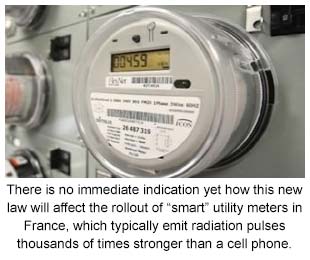
Even though there was much comprised in the end, leading advocates consider the glass half full rather than half empty. “This act, which is the first dedicated to the issue of electromagnetic waves and their impact on the environment and health, marks a first step in the legal recognition of the need to regulate the development of mobile phone communications and all wireless applications,” says the association for the regulation of mobile phone base stations (Priartem). In its view, “this first legislative effort must be an encouragement to go further in protecting people”.
Calls for Caution
This act arrives in a context of accelerated development of sources of electromagnetic fields, in particular with the deployment of very high-speed 4G mobile communications. Aa of January 1st 2015, ANFR indicates the number of 4G base station sites authorized in France was, for all operators, 18,699 – compared to 12,525 a year earlier – and 15,424 are in service.
While there is still no official scientific consensus around the potential health risks from radiofrequencies, many studies and opinions have called for caution. In 2011, the World Health Organization (WHO) classified them as “possibly carcinogenic” . And in 2013, the National Agency Health Safety of Food, Environment and Labour (ANSES) recommended to “limit exposure of the population to radiofrequencies – especially from mobile phones – especially for children and heavy users”. It also called for “controlling the overall exposure from base stations”.
- You are here:
-
Home

- Health