

The Secrets of Sugar - The Fifth Estate - CBC News
We have heard about the dangers of eating too much fat or salt. But there has never been a warning about sugar on our food labels - despite emerging research that suggests the sweet stuff is making more of us fat and sick.
Sugar: The Bitter Truth
University of California Television (UCTV)
Robert H. Lustig, MD, UCSF Professor of Pediatrics in the Division of Endocrinology, explores the damage caused by sugary foods. He argues that fructose (too much) and fiber (not enough) appear to be cornerstones of the obesity epidemic through their effects on insulin. Series: UCSF Mini Medical School for the Public [7/2009] [Health and Medicine] [Show ID: 16717]
Woman Cuts Family Off From WiFi Over Health Concerns
- By Lisa Sigell - May 5, 2015 11:17 PM
 LOS ANGELES (CBS NEWS) - A local mother’s health concerns prompted her to cut her family off from wireless and wants more research conducted into the safety of WiFi.
In the Lawson household, cassette tapes are still in use, as are landline telephones.
Not in use, however, are cellphones, iPads, iPods nor absolutely no wireless connections to the outside world.
“You’re just thinking, ‘I want to live,’ ” said Anura Lawson, a mother and teacher.
Lawson says she started feeling sick in 2012 soon after the Los Angeles Department of Water and Power installed a wireless smart meter on her home.
There are 52,000 of these smart meters being tested in L.A., and the DWP says they’re safe.
But some people claim the radio waves they emit trigger health problems.
“I began to feel dizzy at first,” Lawson said. “Migraines. Heart palpitations.”
Lawson’s daughter, Amira, 22, also experienced trouble.
“My brain was running slower, and I was like, ‘I don’t know what’s going on,’ ” she said.
“There is a syndrome called electromagnetic hypersensitivity,” said Robert Nagourney, an oncologist in Long Beach and professor at UC Irvine.
“There are two kinds of radiation we speak about. One is ionizing, and one is nonionizing,” Nagourney said. “In ionizing radiation, clearly, there’s a great risk of DNA damage, mutation and cancer.”
This danger has not been proven with nonionizing radiation, which is the type emitted by cellphones, smart meters and WiFi.
But with our 21st century explosion of wireless, Nagourney says “we’re bathed in this type of radiation.”
“Does it cause medical illnesses? Great question. Difficult to answer,” the doctor said.
For the Lawson family, who consider themselves sensitive to electromagnetic fields, the smart meter had to go.
Once they got their analogue meter back, Lawson said they felt better healthwise.
But a 1 ½ years later, Lawson says her symptoms returned.
“I began to have migraines. I began to have the heart palpitations,” she said.
It coincided with a change at work as Lawson is an eighth-grade English teacher at Johnnie Cochran Middle School.
In March 2014 to facilitate its iPad program, Lawson says, the “LAUSD decided to install WiFi within my school site.”
With her health deteriorating, Lawson testified before the Board of Education.
“I’m the parent of six children. I want to be around to see them grow up,” she had said. “When I am in the WiFi classroom, I don’t feel good at all.”
“There were a lot of people that were concerned about putting WiFi in the classroom,” said Bill Piazzi, the LAUSD’s environmental assessment coordinator, whose job it is to make sure classrooms are safe.
Where there are WiFi access points, Piazza says, they use a very sophisticated piece of equipment, which measures radio-frequency output.
“We looked very hard at the potential exposures in the classroom,” he said. “No matter where we went, it’s all low.”
Piazza showed CBS2 an emissions report from a classroom that had WiFi.
“These are 30 kids streaming in a classroom, and these are the exposures that they’re getting,” he said “Look how low that is.”
Still, the board in September agreed to turn off the WiFi in Lawson’s classroom.
Now, she is believed to be the first public school teacher in the U.S. granted a health accommodation for electromagnetic hypersensitivity.
“I think the district did a very good job in making a reasonable accommodation for her,” Piazza said.
Lawson’s accommodation applies to her classroom only. To keep her children away from WiFi exposure, her four youngest are being educated at home.
The Lawson’s have Internet at home, but it’s only through a wired connection.
Over the past three years, Lawson says, she has encountered plenty of doubters, which Nagourney says is too bad.
“People are of different sensitivities. We know that one person can get a bee sting and nothing happens. Another person goes into anaphylactic shock. It’s the same bee sting. Different reaction,” he said.
Nagourney says the likelihood of WiFi emissions causing illness is small, “but the chance is not zero.”
Lawson says she would like to see the issue thoroughly researched and believes the newness of wireless makes it impossible to fully understand now how it might one day affect one’s health.
Thus, she’s keeping her kids away from it for as long as she can.
“Teaching doesn’t have to involve a device,” she said. “I think that our students unfortunately are the Guinea pigs, and I don’t think that’s right.”
The LAUSD says it is continuing to study all safety data with respect to WiFi. To view the most recent reports, click here.
Lawson has started an online petition to get WiFi out of California classrooms. For more information, click here. To reach Nagourney, click here.
Lisa Sigell is a reporter for CBS 2 and KCAL 9 where she has worked since July of 2002. You can find her reporting weekdays and during primetime newscasts on KCAL and KCBS.
http://losangeles.cbslocal.com/2015/05/05/woman-cuts-family-off-from-wifi-over-health-concerns/
Booming Organics: U.S. Farmers Forced to Import Organic Crops to Meet Non-GMO Demand

- By Jeffrey Jaxen - April 20, 2015
Due to massive government subsidies given to farmers to grow genetically engineered crops in the past, U.S. food manufacturers and farmers are now being caught blindsided by the sweeping demand for non-gmo and organic crops. In a twist of irony, this is driving a massive increase of organic crop imports from nations that are largely free of bioengineering.
Bloomberg news recently reported that:
“Most of the corn and soybean shipments become feed for chickens and cows so they can be certified organic under U.S. Department of Agriculture guidelines. Organic poultry and dairy operators shun feed made with seeds from Monsanto Co. and other domestic suppliers in favor of foreign products even as the U.S. remains the world’s top grower of corn and soybeans. As a result, imports to the United States of Romanian corn rose to $11.6 million in 2014 from $545,000 the year before. Soybean imports from India more than doubled to $73.8 million.”
After countless years of the public voting with their dollars against GMO food and its associated toxins, the impact is now measurable on every level of the supply chain. At the top, Monsanto is sustaining continual financial loss, major chains like whole foods are being forced to go GMO free, and product manufacturers unwilling to switch are instantly losing market share.
A quick look at the trend confirms the sustained strength of growth in organic food sales is real:
- 2011: Americans spent $29.2 billion on organic foods
- 2012: Americans spent $31.5 billion on organic foods
- 2013: Americans spent $35 billion on organic foods
- 2014: Americans spent $39.1 billion on organic foods
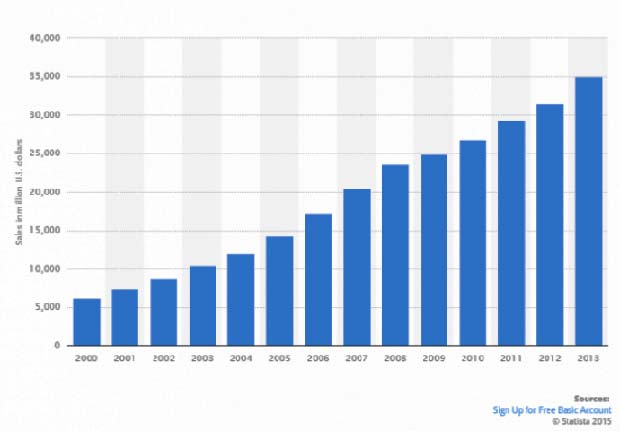
It seems the American GMO experiment is facing hardships having failed socially, financially, and medically. Farmers are seeing the writing on the wall and following the new ‘organic, non-GMO gold rush’ and rapidly switching to meet demands.
The U.S. Department of Agriculture (USDA) recently announced a $66.5 million grant, part of which will support the department’s Organic Agriculture Research and Extension Initiative (OREI). One of OREI’s goals is to identify marketing and policy constraints to the expansion of organic agriculture.
According to Nathaniel Lewis, senior crop and livestock specialist at the Organic Trade Association (OTA):
“The OREI grant will also help fund research on organic weed control methods, which are crucial. “Weeds are the number one barrier to farmers transitioning to organic from a cultural and technical perspective.”
Perhaps the USDA, in its search to identify “marketing and policy constraints” should review its own agency scientist and policy makers who have been attacked, suppressed, and threatened by the biotech industry for continually attempting to expose the dangers of GMO food and its associated toxins.
This article originally appeared at Natural Society.
How GMO foods alter organ function and pose a very real health threat to humans
The Health Ranger, Mike Adams, explains how studies in cell research have demonstrated the mechanism by which micro RNA from genetically engineered foods may alter organ function in humans.
- You are here:
-
Home

- Health