

U.S. Navy's New Laser Weapon Blasts Good or Bad Guys From Air, Sea - Murder by Laser, our tax dollars at work
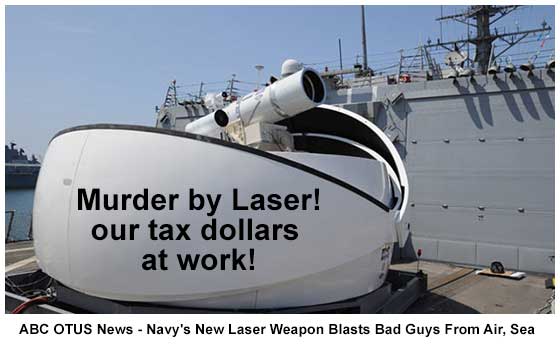
- By LUIS MARTINEZ - ABC OTUS News – April 9, 2013
No longer the fantasy weapon of tomorrow, the U.S. Navy is set to field a powerful laser that can protect its ships by blasting targets with high-intensity light beams.
Early next year the Navy will place a laser weapon aboard a ship in the Persian Gulf where it could be used to fend off approaching unmanned aerial vehicles or speedboats.
The Navy calls its futuristic weapon LAWS, which stands for the Laser Weapon System. What looks like a small telescope is actually a weapon that can track a moving target and fire a steady laser beam strong enough to burn a hole through steel.
A Navy video of testing conducted last summer off the coast of California shows how a laser beam fired from a Navy destroyer was able to set aflame an approaching UAV or drone, sending it crashing into the ocean.
"There was not a single miss" during the testing, said Rear Admiral Matthew Klunder, chief of Naval Research. The laser was three for three in bringing down an approaching unmanned aerial vehicle and 12 for 12 when previous tests are factored in.
But don't expect in that video to see the firing of colored laser bursts that Hollywood has used for its futuristic laser guns. The Navy's laser ray is not visible to the naked eye because it is in the infrared spectrum.
Many of the details about how the laser works remain secret, such as how far its beam can travel, how powerful it is or how much power is used to generate it.
But Navy officials have provided a few unclassified details. For example, the laser is designed to be a "plug and play" system that integrates into a ship's existing targeting technologies and power grids. Those factors make it a surprisingly cheap weapon.
Klunder says each pulse of energy from the laser "costs under a dollar" and it can be used against weapons systems that are significantly more expensive. The Navy says it has spent about $40 million over the past six years in developing the weapon.
Rear Admiral Thomas Eccles, Navy Sea Systems Command, says the beam can be turned on instantly and that ultimately "the generation of power is essentially your magazine. It's the clip we have" instead of bullets. "We deliver precision with essentially an endless supply of rounds."
Some new technological fixes, what Klunder calls "a secret sauce," have been developed to improve the degrading of lasers over distance as well as maintaining a lock on a target from a moving ship.
The strength of the beam is flexible enough that at a lower intensity level it can be used to warn approaching ships and UAV's not to get too close to a Navy ship. Instead of using machine guns to fire non-lethal warning shots as Navy ships do now, the laser can be aimed to "dazzle" the viewing sensors aboard the craft. That light effect warns the pilot of a small water craft or at the controls of a UAV that they are being targeted by a laser and to turn away. If they don't, the laser's power can be boosted to destroy the approaching craft.
Based on earlier testing the Navy is confident the laser is ready for real-world testing aboard the USS Ponce in the Persian Gulf. The ship was selected because of its mission to be an enduring presence in the Gulf to counter Iranian maritime threats in the region. Coincidentally Iran uses small fast boats to harass American warships in the waters of the Persian Gulf.
How might Iran feel about the new weapon? "Frankly I hope it sends a message to some of our potentially threatening adversaries out there to know that we mean business," said Klunder. "This is a system where if you try to harm our vessels that I hope you will take a very, very serious moment of pause to think about that before you do it because this system will destroy your vessel or will destroy your UAV."
The Navy wants the ship's crew to use the same techniques and methods they use with their other defensive weapons systems.
While for now the laser will be used primarily against slow-moving UAV's and fast boats cruising at speeds of 50 knots, the Navy sees the system's capabilities expanding over time to target faster weapons.
"There's absolutely every intention that with the development of this system and follow-on upgraded systems we will eventually be able to take higher speeds in-bound," said Klunder.
* Dr. Judy Wood - Warmongering Weapon Manufacturers Are Able To Disrupt Molecular Bonds Of Matter, Using Directed Energy Weapon
NATO air strike kills 11 Afghan children, officials say
Latest update: 08/04/2013 - © AFP
An air strike in Afghanistan carried out by NATO forces has killed 11 children in the eastern part of the country, officials said on Sunday. Afghanistan’s president condemned the loss of civilian lives.
A NATO air attack in eastern Afghanistan has killed 11 children, officials said Sunday, the latest case of civilian casualties which provoke great anger in the war-torn country.
The children were killed during a joint Afghan-NATO operation in the Shigal district of restive Kunar province bordering Pakistan late on Saturday.
An Afghan official involved in the operation who did not want to be named said air support was called in after local and coalition forces came under attack, resulting in the death of an American and injuries to several Afghan soldiers.
The official said the force did not know there were women and children in the houses that were hit.
Civilian casualties caused by NATO forces have been one of the most contentious issues in the 11-year campaign against Taliban insurgents, provoking harsh criticism from Afghan President Hamid Karzai and angry public protests.
The president "strongly condemned the ISAF air strike in Kunar that killed 11 children," in a statement issued by his office.
"The president, while condemning the use of civilians as shields by the Taliban, denounced any kind of operations that cause civilian deaths," the statement said.
Local officials including Shigal district governor Abdul Zahir had earlier given a death toll of 10 children killed and six women wounded, while Sayed Rahman, security commander of Shigal, said one woman was also among the dead.
A spokesman for NATO's International Security Assistance Force (ISAF) confirmed the strike and said the coalition was gathering information to determine what happened.
A US civilian died in a militant attack at the scene, ISAF said.
The interior ministry said in a statement the attack by coalition forces killed six Taliban including two senior commanders.
On Thursday a NATO air strike killed four Afghan policemen and two civilians during a pre-dawn clash with Taliban at a police post in eastern Ghazni province.
After an air strike killed 10 civilians, mostly women and children, in February, Karzai banned Afghan security forces from calling in NATO air strikes.
However it is unclear whether the ban has been enforced and many operations are jointly run by NATO and Afghan forces.
The latest strike came a day after at least five Americans, including a young female diplomat, were killed in two Taliban attacks in the country's east and south.
A suicide car bomber struck a NATO convoy in the southern province of Zabul Saturday, killing three US soldiers and two civilians, one of whom was a female US diplomat.
They were travelling with Afghan officials to distribute books to students. The nationality of the second civilian was unclear.
Another US civilian was killed in an attack in the east, making it the deadliest day for the coalition since July 8 last year.
Though the Taliban have not yet announced their "spring offensive", which started last year with a barrage of bloody attacks in early May, the traditional Afghan fighting season is beginning as the cold winter recedes.
US-led coalition forces are winding down their operations before a scheduled withdrawal of the bulk of their 100,000 troops by the end of 2014, and racing to prepare Afghan forces to take over responsibility for security.
But a brazen attack last Wednesday -- when Taliban gunmen killed 46 people at a court in the western city of Farah to try to free insurgents standing trial -- raised further questions about the Afghans' ability to secure the country.
The Farah death toll was the highest in Afghanistan from a single attack since a Shiite Muslim shrine was bombed in Kabul in December 2011, killing 80 people.
IRS claims it can read your e-mail without a warrant
The ACLU has obtained internal IRS documents that say Americans enjoy "generally no privacy" in their e-mail messages, Facebook chats, and other electronic communications.
- By Declan McCullagh - April 10, 2013
The Internal Revenue Service doesn't believe it needs a search warrant to read your e-mail.
Newly disclosed documents prepared by IRS lawyers say that Americans enjoy "generally no privacy" in their e-mail, Facebook chats, Twitter direct messages, and similar online communications -- meaning that they can be perused without obtaining a search warrant signed by a judge.
That places the IRS at odds with a growing sentiment among many judges and legislators who believe that Americans' e-mail messages should be protected from warrantless search and seizure. They say e-mail should be protected by the same Fourth Amendment privacy standards that require search warrants for hard drives in someone's home, or a physical letter in a filing cabinet.
An IRS 2009 Search Warrant Handbook obtained by the American Civil Liberties Union argues that "emails and other transmissions generally lose their reasonable expectation of privacy and thus their Fourth Amendment protection once they have been sent from an individual's computer." The handbook was prepared by the Office of Chief Counsel for the Criminal Tax Division and obtained through the Freedom of Information Act.
Nathan Wessler, a staff attorney at the ACLU's Speech, Privacy & Technology Project, said in a blog post that the IRS's view of privacy rights violates the Fourth Amendment:
Let's hope you never end up on the wrong end of an IRS criminal tax investigation. But if you do, you should be able to trust that the IRS will obey the Fourth Amendment when it seeks the contents of your private emails. Until now, that hasn't been the case. The IRS should let the American public know whether it obtains warrants across the board when accessing people's email. And even more important, the IRS should formally amend its policies to require its agents to obtain warrants when seeking the contents of emails, without regard to their age.
The IRS continued to take the same position, the documents indicate, even after a federal appeals court ruled in the 2010 case U.S. v. Warshak that Americans have a reasonable expectation of privacy in their e-mail. A few e-mail providers, including Google, Microsoft, Yahoo, and Facebook, but not all, have taken the position that Warshak mandates warrants for e-mail.
The IRS did not immediately respond to a request from CNET asking whether it is the agency's position that a search warrant is required for e-mail and similar communications.
Before the Warshak decision, the general rule since 1986 had been that police could obtain Americans' e-mail messages that were more than 180 days old with an administrative subpoena or what's known as a 2703(d) order, both of which lack a warrant's probable cause requirement.
The rule was adopted in the era of telephone modems, BBSs, and UUCP links, long before gigabytes of e-mail stored in the cloud was ever envisioned. Since then, the 6th Circuit Court of Appeals ruled in Warshak, technology had changed dramatically: "Since the advent of e-mail, the telephone call and the letter have waned in importance, and an explosion of Internet-based communication has taken place. People are now able to send sensitive and intimate information, instantaneously, to friends, family, and colleagues half a world away... By obtaining access to someone's e-mail, government agents gain the ability to peer deeply into his activities."
A March 2011 update to the IRS manual, published four months after the Warshak decision, says that nothing has changed and that "investigators can obtain everything in an account except for unopened e-mail or voice mail stored with a provider for 180 days or less" without a warrant. An October 2011 memorandum (PDF) from IRS senior counsel William Spatz took a similar position.
A phalanx of companies, including Amazon, Apple, AT&T, eBay, Google, Intel, Microsoft, and Twitter, as well as liberal, conservative, and libertarian advocacy groups, have asked Congress to update the 1986 Electronic Communications Privacy Act to make it clear that law enforcement needs warrants to access private communications and the locations of mobile devices.
In November, a Senate panel approved the e-mail warrant requirement, and last month Rep. Zoe Lofgren, a Democrat whose district includes the heart of Silicon Valley, introduced similar legislation in the House of Representatives. The Justice Department indicated last month it will drop its opposition to an e-mail warrant requirement.
The American Made H7N9 Flu
Chinese colonel says latest bird flu virus is U.S. biological weapon

- BY Bill Gertz - April 9, 2013 - Associated Press
A Chinese Air Force officer on Saturday accused the U.S. government of creating the new strain of bird flu now afflicting parts of China as a biological warfare attack.
People’s Liberation Army Sr. Col. Dai Xu said the United States released the H7N9 bird flu virus into China in an act of biological warfare, according to a posting on his blog on Saturday.
The charge was first reported in the state-run Guangzhou newspaper Southern Metropolis Daily and then picked up by several news outlets in Asia.
State Department spokesman Jason Rebholz dismissed the claim. “There is absolutely no truth to these allegations,” he told the Washington Free Beacon.
Seven deaths from the bird flu outbreak were reported as of Tuesday in state-run Chinese media. As many as 24 people reportedly were infected by the disease in Shanghai, Jiangsu, Zhejiang, and Anhui.
Chinese authorities are trying to calm public fears of a major epidemic, claiming there is no evidence the virus can be transmitted between humans.
The government also is claiming that the outbreak is not related to the recent discovery of thousands of dead pigs floating in a river in China.
The accusation of U.S. biological warfare against China comes as the Pentagon is seeking closer military relations with China. Army Gen. Martin Dempsey, chairman of the Joint Chiefs of Staff, is set to travel to China for talks with Chinese military leaders later this month.
Dai is a military strategist who in the past has been outspoken in seeking to foment conflict between China and the United States. He told the Global Times in August that China should go to war over U.S. support for Japan’s claims to the disputed Senkaku Islands.
Writing on Sina Weibo, a Chinese microblogging site akin to Twitter, Dai stated that the new bird flu strain was designed as a biological weapon similar to severe acute respiratory syndrome (SARS), which he also claimed was developed as a U.S. bio-weapon, that affected the country in 2003.
According to Dai’s posting, the new flu outbreak should not be a cause for concern. “The national leadership should not pay too much attention to it,” the PLA lecturer at the National Defense University wrote. “Or else, it’ll be like in 2003 with SARS!”
“At that time, America was fighting in Iraq and feared that China would take advantage of the opportunity to take other actions,” he said. “This is why they used bio-psychological weapons against China. All of China fell into turmoil and that was exactly what the United States wanted. Now, the United States is using the same old trick. China should have learned its lesson and should calmly deal with the problem.”
Dai said that even if “a few may die” from the flu outbreak, it will not equal one-thousandth of the deaths caused by vehicle accidents in China.
Dai in the past has called for China to punish the United States for U.S. arms sales to rival Taiwan, by selling arms to U.S. enemies. “China recognizes that a few perfunctory protests will not have any effect,” Dai said in 2010. “China can’t directly sanction American arms companies since they did not do business with China … but China can sanction companies that are doing business with China directly, like Boeing or General Electric.”
Dai also has said the United States has used crises with North Korea and offers of cooperation on the issue as a plot to drive a wedge between Beijing and its fraternal communist ally.
Dai also has said U.S. efforts to counter Chinese espionage and intelligence-gathering were part of a U.S. “plot theory” of “western countries threatening others by [releasing] information gained through spying in order to damage the reputations of other countries.”
A State Department official said China notified the World Health Organization (WHO) on March 31 about its first detected human cases of H7N9 infection. Fourteen cases were confirmed by the WHO by April 5, of which six were fatal. The organization said there is no evidence of human-to-human transmission.
“U.S. Embassy Beijing and U.S. Consulate Shanghai are monitoring the situation, working closely with counterparts at the U.S. Centers for Disease Control, and the Beijing and Shanghai municipal governments,” the official said.
The colonel’s accusation provoked a widespread response on Chinese websites. One post in reaction joked that Dai’s comment about auto deaths must mean that the United States and Germany are responsible for a conspiracy to produce cars, according to a report in Hong Kong’s South China Morning Post.
Luo Changping, deputy editor of Caijing, said most PLA soldiers would not support Dai’s comments and he urged the colonel to resign and apologize to those who have died from the current bird flu outbreak.
A defiant Dai then said in a new posting Sunday that “it is common knowledge that a group of people in China have been injected with mental toxin by the United States.”
“Now, a group of fake American devils are attacking me,” he wrote in another post. “I will not retreat even half a step.”
Analysts say the colonel’s remarks are a reflection of the growing xenophobic atmosphere within the Chinese military that views the United States as its main enemy.
Former State Department intelligence analyst John Tkacik said China’s military was largely to blame for mishandling the 2003 outbreak of SARS. Tkacik said there was speculation when the epidemic began that “the PLA suspects SARS had emanated from its own biological laboratories and was all the more eager to keep it secret.” China is known to have a covert biological arms program.
“Col. Dai Xu is a shameless liar when he accuses the United States of using bio weapons,” Tkacik told the Free Beacon. “He’s probably motivated by a desire to exculpate the PLA for their mishandling of the epidemic—no doubt most Chinese have happily forgotten the episode—as much as by a cynical xenophobia. But, that’s what passes for deep strategic thought at China’s National Defense University these days.”
The Pentagon has been trying with varying success to develop closer ties to the Chinese military as part of a strategy aimed at building trust. However, China’s military leaders believe the U.S. offers of closer ties are a ruse designed to contain China’s growing military buildup.
Defense Secretary Chuck Hagel spoke by phone with China’s Defense Minister Gen. Chang Wanquan on April 2. Chang is the No. 4 defense official after Chinese President Xi Jinping and two other generals who run the Central Military Commission, the Communist Party’s ultimate power organ.
“The leaders both expressed their intention to work together to continue to build a military-to-military relationship that serves the vision of both President Obama and President Xi,” Pentagon press secretary George Little said in a statement after the call.
“The secretary discussed the importance of focusing on areas of sustained dialogue, practical areas of cooperation, and risk reducing measures,” he said.
U.S. ties with China are strained due to China’s reluctance to rein in neighboring North Korea.
China provides North Korea with large amounts of fuel oil and other goods. However, Beijing has not taken steps to pressure Pyongyang using its economic leverage during the ongoing crisis.
The flu has lit up China’s thriving Internet, according to analysts. Over 945,600 microblog postings addressed the flu between April 8 and 9. Since the outbreak began some seven days ago, between 1.3 million and 3 million postings were put online on outlets including Sina Weibo and QQ Weibo.
Tens of thousands of users expressed doubts about the official Shanghai municipal government’s denial of any link between the dead pigs found floating last month in the region’s Huangpu River.
The proximity to the initial outbreak in Shanghai and the river has led to speculation that the pig deaths may have been linked to the flu virus jumping from animals to humans.
That speculation was fueled by reports that one of the victims of the flu was a pig butcher.
The avian flu strain is similar to an earlier outbreak with a significant difference: The current strain does not kill the birds it infects, making it more difficult to identify infected poultry.
The Shanghai government waited 20 days before announcing the first H7N9 infection on March 31.
- You are here:
-
Home

- News