

Learn From The Criminal Nation-less Corporations, How To Avoid Paying Taxes
For Many of the U.S. Nation-less Corporation's Money ‘Offshore’ Means: New York, Manhattan
- By DAVID KOCIENIEWSKI - May 21, 2013 - The New York Times
Like some of the nation’s prominent chief executives, Apple’s Timothy D. Cook has a simple proposal to help spur the economy and encourage corporate tax compliance: give American companies a tax break to bring to the United States untaxed profits parked overseas.
But much of that money is already home.
Nation-less Corporations based in the United States now hold more than $1.6 trillion in cash classified as “permanently invested overseas.” These funds will face the 35 percent federal corporate tax only if it is returned to the country.
In the convoluted world of corporate tax accounting however, simple concepts like “overseas” and “returned to the country” are not as simple as they appear.
Apple’s $102 billion in offshore profits is actually managed by one of its wholly owned subsidiaries in Reno, Nev., according to the Senate report on the company’s tax avoidance. The money is tracked by Apple company bookkeepers in Austin, Tex. What’s more, the funds are held in bank accounts in New York.
Because the $102 billion is technically assigned to two Irish subsidiaries, however, the United States tax code considers the money to be under foreign control, and Apple is legally entitled to avoid paying taxes on it.
Tax experts say that such an arrangement is not uncommon among American multinationals. During the last several years, major companies like Microsoft, Hewlett-Packard, Google and Abbott Labs have lowered their tax bills by arranging for their billions in profits to flow to subsidiaries that are technically offshore — even though some of the money is placed in United States Treasury bonds and other government securities.
Because the money is nominally held by the offshore companies, the tax code deems the money nontaxable, even if the funds are physically held in the United States. The savings to American companies is huge: the Congressional Joint Committee on Taxation estimated that if foreign profits of United States corporations were fully taxed it would generate an additional $42 billion this year for the government — about half the amount of the automatic spending cuts enacted as part of the so-called sequester.
The companies say that they need to shield their money overseas, however, because the official corporate rate of 35 percent is the highest in the world and puts them at a competitive disadvantage. And while the offshore money may be in American banks and controlled from home, executives say it would be irresponsible to return the money to their shareholders or invest it in the United States because of the high tax rate.
Just last month, Apple announced it would pay for its dividends to shareholders by taking on $17 billion in debt rather than tap into the untaxed foreign profits. Mr. Cook said it would have been a disservice to shareholders to use the “offshore” earnings and pay the 35 percent federal income tax.
But Senator Carl Levin, the Michigan Democrat who heads the committee, brushed aside those claims. “You can bring the money home,” he said. “You’d just have to pay your taxes on it.”
Apple is one of about 20 major corporations that have been pushing for a fresh tax break, known as a “repatriation holiday,” which would allow them to bring the money to the United States at a drastically reduced rate. John T. Chambers, chief executive of Cisco, has led a sustained lobbying effort for such a policy, promising that it would act as a stimulus to encourage investment and increase jobs in the United States.
A similar policy was enacted in 2004, which prompted American companies to return more than $300 billion in foreign earnings at the reduced rate of 5.25 percent. But it led to no discernible increase in American investment or hiring. On the contrary, some of the companies that brought back the most money laid off thousands of workers, and a study by the National Bureau of Economic Research later concluded that 92 cents on every dollar was used for dividends, stock buybacks or executive bonuses. A study by the Congressional Joint Committee on Taxation estimated that a similar program would result in $79 billion in forgone tax revenue over a decade.
Opponents of the repatriation tax break say that Apple’s accounting maneuvers show how easily major companies can shield their profits from the government, even putting companies without aggressive tax departments at a competitive disadvantage.
“The offshore companies are a fiction and the statement that the money is offshore is a fiction,” said Edward D. Kleinbard, former staff director for the Congressional Joint Committee on Taxation. “What they are asking for is a reward for having gamed the system.”
Who Built The Pyramids and the Orion's Belt Connection
- By Nassim Haramein - 2014
The facts and the truth about who built the hundreds of Pyramids all over the world? Nassim Haramein presents extensive evidence proving the traditional views wrong and false. This is a must see video..!
U2 group singer, Bono partners with Monsanto, G8, to Biowreck Africa

- By: Rady Ananda - Friday, June 1, 2012
At the G8 Summit held two weeks ago at Camp David, President Obama met with private industry and African heads of state to launch the New Alliance for Food Security and Nutrition, a euphemism for monocultured, genetically modified crops and toxic agrochemicals aimed at making poor farmers debt slaves to corporations, while destroying the ecosphere for profit.
And Bono, of the rock group U2, is out shilling for Monsanto on this one.
It’s phase 2 of the Green Revolution. Tanzania, Ghana, and Ethiopia are the first to fall for the deception, with Mozambique, Cote d’Ivoire, Burkina Faso and other African nations lining up for the "Grow Africa Partnership," under Obama’s "Global Agricultural Development" plan.
In Obama Pitches India Model of GM Genocide to Africa, Scott Creighton writes:
But African civil society wants no part of this latest Monsanto aligned 'public private partnership.’ Whatever will the progressives do now that their flawless hero has teamed up with their most hated nemesis to exploit an entire continent like they did to India not that long ago?
With a commitment of $3 billion, Obama plans to 'partner up’ with mega-multinationals like Monsanto, Diageo, Dupont, Cargill, Vodafone, Walmart, Pepsico, Prudential, Syngenta International, and Swiss Re because, as one USAID representative says 'There are things that only companies can do, like building silos for storage and developing seeds and fertilizers.’
Of course, that’s an outrageous lie. Private citizens have been building their own silos for centuries. But it’s true that only the biowreck engineers will foist patented seeds and toxic chemicals on Africa.
Creighton continues:
Bono says that there has to be a 'public private partnership’ in order to get this done and that they are going to be using the ideas of the African people and farmers. Really? This is what the African farmers say to that…
'We request that: – governments, FAO, the G8, the World Bank and the GAFSP reconsider their promotion of Public/Private Partnerships which, as they are now conceived, are not suitable instruments to support the family farms which are the very basis of African food security and sovereignty.’ African Civil Society Organizations
I wonder if that could be any clearer. They don’t WANT the public private partnerships involved in this process…. It’s not enough that huge mega-corporations are bleeding the nations of Africa dry by sucking the valuable mineral resources out of their hills. No. As Bono says about the development in Africa:
'They’re future consumers for the United States. The president is talking business. This is good. It’s a whole new development paradigm today. The old donor/recipient relationship… it’s over.’ Volatility chimed in:
The history of corporate agriculture and its 'Green Revolution’ is a perfect example of the unfulfilled promises, and therefore proven lies, of corporatism. What was the Green Revolution? With a huge one-off injection of fossil fuels, and building upon ten thousand years of agronomy, corporate agriculture temporarily increased yields within the monoculture framework.
But, in the Green Revolution, writes Volatility:
The soil is stripped of all nutrition and zombified by ever-increasing applications of synthetic fertilizer. Monoculture is ever more dependent on the increasing application of ever more toxic herbicides and pesticides. Deployment of GMOs escalates these vulnerabilities. Factory farms can exist only with ever increasing use of antibiotics. All these systems are extremely tenuous, vulnerable, not robust, not resilient. They’re all guaranteed to collapse. Hermetic monoculture, and industrial agriculture as such, is one big hothouse flower which requires perfect conditions to survive….
[T]he Green Revolution was a scam to use cheap fossil fuels to increase monocrop yield, drive tens of millions off the land, and use the stolen land and food to render food temporarily artificially cheap for Western consumerism.
Like with Monsanto’s Bt cotton deployed in India, at first yields improved and farmers profited. Now, however, according to a leaked Advisory from the Minister of Agriculture obtained by the Hindustan Times last month:
Cotton farmers are in a deep crisis since shifting to Bt cotton…. In fact cost of cotton cultivation has jumped…due to rising costs of pesticides. Total Bt cotton production in the last five years has reduced.
The Advisory definitively links farmer suicides to debt-enslavement enabled by the synthetic food model spawned by Monsanto, Dupont and other ecocidal corporations: "The spate of farmer suicides in 2011-12 has been particularly severe among Bt cotton farmers."
That is not all the harm wrought by the petrochemical synthetic ag industry, as this 2012 superweed map by the University of Wisconsin shows:
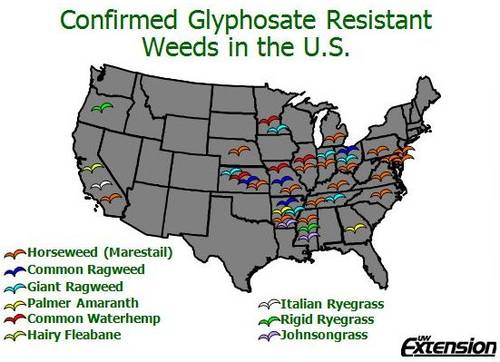
Over half of US states are now plagued by agrochemically-induced superweeds. An industry sponsored study of pesticide use predicts that by 2016, nearly a billion pounds of these toxic chemicals will be poured on US soils.
Big Criminal Banks Get Break in Rules to Limit Risks
- By BEN PROTESS - May 15, 2013- The New York Times
Under pressure from Wall Street lobbyists, federal regulators have agreed to soften a rule intended to rein in the banking industry’s domination of a risky market.
The changes to the rule, which will be announced on Thursday, could effectively empower a few big banks to continue controlling the derivatives market, a main culprit in the financial crisis.
The $700 trillion market for derivatives — contracts that derive their value from an underlying asset like a bond or an interest rate — allow companies to either speculate in the markets or protect against risk.
It is a lucrative business that, until now, has operated in the shadows of Wall Street rather than in the light of public exchanges. Just five banks hold more than 90 percent of all derivatives contracts.
Yet allowing such a large and important market to operate as a private club came under fire in 2008. Derivatives contracts pushed the insurance giant American International Group to the brink of collapse before it was rescued by the government.
In the aftermath of the crisis, regulators initially planned to force asset managers like Vanguard and Pimco to contact at least five banks when seeking a price for a derivatives contract, a requirement intended to bolster competition among the banks. Now, according to officials briefed on the matter, the Commodity Futures Trading Commission has agreed to lower the standard to two banks.
About 15 months from now, the officials said, the standard will automatically rise to three banks. And under the trading commission’s new rule, wide swaths of derivatives trading must shift from privately negotiated deals to regulated trading platforms that resemble exchanges.
But critics worry that the banks gained enough flexibility under the plan that it hews too closely to the “precrisis status.”
“The rule is really on the edge of returning to the old, opaque way of doing business,” said Marcus Stanley, the policy director of Americans for Financial Reform, a group that supports new rules for Wall Street.
Making such decisions on regulatory standards is a product of the Dodd-Frank Act of 2010, which mandated that federal agencies write hundreds of new rules for Wall Street. Most of that effort is now complete at the trading commission. But across several other agencies, nearly two-thirds of the rules are unfinished, including some major measures like the Volcker Rule, which seeks to prevent banks from trading with their own money.
The deal over derivatives was forged from wrangling at the five-person commission, which was sharply divided. Gary Gensler, the agency’s Democratic chairman, championed the stricter proposal. But he met opposition from the Republican members on the commission, as well as Mark Wetjen, a Democratic commissioner who has sided with Wall Street on other rules.
Mr. Wetjen argued that five banks was an arbitrary requirement, according to the officials briefed on the matter. In advocating the two-bank plan, he also noted that the agency would not prevent companies from seeking additional price quotes. Other regulators have proposed weaker standards.
Mr. Gensler, eager to rein in derivatives trading but lacking an elusive third vote, accepted the deal. By his reckoning, the compromise was better than no rule at all.
In an interview on Wednesday, Mr. Gensler said that, even with the compromise, the rule will still push private derivatives trading onto regulated trading platforms, much like stock trading. He also argued that the agency plans to adopt two other rules on Thursday that will subject large swaths of trades to regulatory scrutiny.
“No longer will this be a closed, dark market,” Mr. Gensler said. “I think what we’re planning to do tomorrow fulfills the Congressional mandate and the president’s commitment.”
Yet the deal comes at an awkward time for the agency. Mr. Gensler, who was embraced by consumer advocates but scorned by some on Wall Street, is expected to leave the agency later this year now that his term has technically ended.
In preliminary talks about filling the spot, the White House is expected to consider Mr. Wetjen, a former aide to the Senate majority leader, Harry Reid. The administration, according to people briefed on the matter, is also looking at an outsider as a potential successor: Amanda Renteria, a former Goldman Sachs employee and Senate aide.
The prospect of someone other than Mr. Gensler completing the rules provided some momentum for the compromise, officials say. The officials also noted that Mr. Gensler had set a June 30 deadline for completing the plan.
The White House declined to comment. Mr. Gensler, who has not said whether he will seek a second term at the agency, declined to discuss his plans on Wednesday.
While the regulator defended the derivatives rule, consumer advocates say the agency gave up too much ground. To some, the compromise illustrated the financial industry’s continued influence in Washington.
“The banks have all these ways to reverse the rules behind the scenes,” Mr. Stanley said.
The compromise also alarmed Bart Chilton, a Democratic member of the agency who has called for greater competition in the derivatives market. Still, Mr. Chilton signaled a willingness to vote for the rule.
“At the end of the day, we need a rule and that may mean some have to hold their noses,” he said.
The push for competition follows concerns that a handful of select banks — JPMorgan Chase, Citigroup, Bank of America, Morgan Stanley and Goldman Sachs — control the market for derivatives contracts.
That grip, regulators and advocacy groups say, empowers those banks to overcharge some asset managers and companies that buy derivatives. It also raises concerns about the safety of the banks, some of which nearly toppled in 2008.
“It’s important to remember that the Wall Street oligopoly brought us the financial crisis,” said Dennis Kelleher, a former Senate aide that now runs Better Markets, an advocacy group critical of Wall Street.
With that history in mind, Congress inserted into Dodd-Frank a provision that forces derivatives trading onto regulated trading platforms. The platforms, known as swap execution facilities, were expected to open a window into the secretive world of derivatives trading. But Congress left it to Mr. Gensler’s agency to explain how they would actually work.
There was a time when Mr. Gensler envisioned the strictest rule possible. In 2010, he pushed a plan that could, in essence, make all bids for derivatives contracts public. Facing complaints, the agency instead proposed a plan that would require at least five banks to quote a price for derivatives passing through a swap execution facility.
But even that plan prompted a full-court press from Wall Street lobbyists. Banks and other groups that opposed the plan held more than 80 meetings with agency officials over the last three years, an analysis of meeting records shows. Goldman Sachs attended 19 meetings; the Securities Industry and Financial Markets Association, Wall Street’s main lobbying group, was there for 11.
The banks also benefited from some unlikely allies, including large asset managers that buy derivatives contracts. While money managers may seem like natural supporters of Mr. Gensler’s plan — and some in fact are — the industry’s largest players already receive significant discounts from select banks, providing them an incentive to oppose Mr. Gensler’s plan.
The companies cautioned that, because Mr. Gensler’s plan would involve a broader universe of banks, it could cause leaks of private trading positions. The plan, the companies said, would not necessarily benefit the asset managers.
“If someone told me I needed to shop five different places for a pair of jeans, I don’t see how that would help me,” said Gabriel D. Rosenberg, a lawyer at Davis Polk, which represents Sifma and the banks.
The banks and asset managers also warned that many derivatives contracts are traded too infrequently to even generate attention from five banks.
Some regulators dispute that point. They point to the industry’s own data, which shows that 85 percent of derivatives trading in a recent 10-day span occurred in four products that are arguably quite liquid. (Each traded more than 500 times.)
As such, according to officials briefed on the matter, Mr. Chilton proposed a plan to require quotes to be submitted to at least five banks for the most liquid contracts. Under his plan, contracts that were less liquid could still be subject to at least two.
Mr. Wetjen, who saw the effort as too complicated, continued to favor the two-bank plan. While the requirement jumps to three banks in about 15 months, the agency might also have to produce a study that could undermine that broader standard.
In an interview, Mr. Wetjen explained that he was seeking to grant more flexibility to the markets. “If flexibility means it’s more beneficial to the banks, so be it,” he said. “But it also means it’s more flexible to all market participants and the marketplace as a whole.”
Some consumer advocates have raised broader concerns about Mr. Wetjen, who once advocated a wider than expected exemption to part of a derivatives rule. They also complained that Mr. Wetjen has split with Mr. Gensler on aspects of a plan to apply Dodd-Frank to banks trading overseas. He has, however, voted with Mr. Gensler on every rule, unlike the other commissioners.
Mr. Wetjen also noted that his actions often upset the banks. On only a few issues, he happened to agree with them.
“I’m not driven by who wages the argument,” he said. “It’s about what policy makes sense.”
- You are here:
-
Home

- News