

Anonymous, Karl Rove and 2012 Election Fix?
- By Thom Hartmann and Sam Sacks - The Daily Take - Monday, 19 November 2012
At around 11:25 pm EST on election night, Karl Rove knew something had gone terribly wrong.
 Minutes earlier, Fox News called the key battleground state of Ohio for President Obama, sealing his re-election. But as the network took live shots of jubilant Obama supporters celebrating their victory camped outside the Obama re-election headquarters in Chicago, Karl Rove began building a case against the call his employer network had just made.
Rove explained that when Fox called Ohio, only 74% of the vote was in showing President Obama with a lead of roughly 30,000 votes. But, as Rove contended, with 77% reporting according to the Ohio Secretary of State office, the President’s lead had been slashed to just 991 votes.
“We gotta be careful about calling the thing,” Rove said, “I’d be very cautious about intruding in on this process.”
Rove was supremely confident that the numbers coming in from Ohio throughout the night that favored President Obama weren’t indicative of who would win Ohio when all the votes were ultimately tabulated by the state's computers. With a quarter of the vote still out there, Rove was anticipating a shift to the Right just after 11 pm, which, coincidentally, is exactly what happened in 2004.
That year, John Kerry and the entire nation were watching Ohio just after the 11pm hour. Florida had just been called for George W. Bush and according to the Electoral College math whoever won Ohio would win the election. And considering that exit polls from the state showed John Kerry with a substantial lead, there were a lot of tense moments for Karl Rove and the Republicans that night.
Then the clock struck 11:14pm, and the servers counting the votes in Ohio crashed. Election officials had planned for this sort of thing to happen and already contracted with a company in Chattanooga, Tennessee called SMARTech to be the fail-safe should the servers in Ohio go down.
As journalist Craig Unger lays bare in his book, Boss Rove, SMARTech was drenched in Republican politics. One of the early founders of the company was Mercer Reynolds who used to the finance chairman of the Republican Party. SMARTech’s top client was none other than the Bush-Cheney campaign itself and SMARTech also did work for Jeb Bush and the Republican National Committee. And it was Ohio’s Republican Secretary of State, Ken Blackwell, who ensured that SMARTech received the contract to count votes on election night should the servers go down, which they did at exactly 11:14pm.
Sixty long seconds later the servers came back up in Ohio, but now with vote rerouted through SMARTech in Chattanooga. And, coincidentally, Bush’s prospects for re-election were suddenly a lot brighter. The vote totals that poured into the system from SmartTECH's computer in Chattanooga were flipping the exit polls on their head. The lead Kerry had in the exit polls had magically reversed by more than 6%, something unheard of in any other nation in the developed world, giving Bush the win in Ohio and the presidency for another four years.
Unger further explains in his book that the only independent analysis of what happened in Ohio was done by Richard Hayes Phillips and published in the book, Witness to a Crime. Phillips and his team analyzed more than 120,000 ballots, 127 polls books, and 141 signature books from Ohio’s 2004 election.
Phillips found zero irregularities in vote totals from all the counties that reported results before the servers crashed at 11:14pm. But of the fourteen counties that came in after the crash connected Ohio's election computers to SmartTECH's computers in Chattanooga, every single one of them showed voter irregularities - that all favored George W. Bush.
For example, consider Cleveland’s Fourth Ward. In 2000, Al Gore won 95% of that ward's vote. But in 2004, the county reported its results after the 11:14 pm crash, and it showed that Kerry had only won 59% of the vote – a 35% drop without any explanation. There were several other abnormalities across Ohio’s post-server crash that delivered the state to Bush.
John Kerry never protested the election and to this day, these 2004 voter abnormalities have never been addressed.
So the question is: on election night this year, when Karl Rove was protesting the call his network had just made in Ohio, was Rove anticipating a wave of unpredicted vote totals to swing the election back to Mitt Romney after a statewide server crash, just as had happened in 2004?
Perhaps. He did make the point that the race was about to drastically narrow according to the Secretary of State’s office. And as The Free Press reports, a number of odd similarities with 2004 began occurring in Ohio this year just after the 11pm hour once again:
“Curiously, the Ohio Secretary of State’s vote tabulation website went down at 11:13pm, as reported by Free Press election protection website monitors, and mentioned by Rove on the news. This was one minute earlier than the time on election night 2004 -- when Ohio votes were outsourced to Chattanooga, Tennessee -- and then the vote flipped for Bush…This time, the Cuyahoga County (Cleveland) vote tabulation site went down as on election night as well. In his rant on Fox, Rove argued that Fox News should not confirm Ohio for Obama until votes came in from the southwest Ohio GOP strongholds of Delaware, Butler and Warren counties and suburban Cincinnati. It was after the crash of the secretary of state’s site in 2004 that improbable vote totals came in from Republican counties in southwest Ohio – particularly Butler, Clermont, and Warren counties. These three counties provided more than Bush’s entire Ohio victory margin of 119,000.”
Only this time, when the servers came back up, the votes never flipped. President Obama’s lead held and he went on to win, while Karl Rove - and Mitt Romney - watched in slack-jawed amazement.
We know there was a parade of Conservative talking heads in the days before the election predicting a landslide victory for Mitt Romney. Is it because they lived in a bubble, lacking pollster Nate Silver’s facts and arithmetic that actually showed the President winning in a landslide? Could it be that Rove’s election night freak-out was just a result of this same Election Day ignorance held by all Republicans? Or was Rove genuinely shocked by what he was seeing because he knew the fix was in, just like in 2004, and there was no way President Obama was going to win re-election?
And if that’s the case, why did the plan to steal the election not work?
Here’s where the story gets really interesting.
Just a few weeks before Election Day, the hacktivist group Anonymous issued a video statement against Karl Rove. Anonymous is notorious for numerous cyber actions against the Justice Department, the Pentagon, the Recording Industry of America, the Motion Picture Association of America, and even the Church of Scientology.
In the video released prior to Election Day, Anonymous warns Karl Rove that he’s being watched. “We know that you will attempt to rig the election of Mitt Romney to your favor,” a black-robed figure in a Guy Fawkes mask says in the video. “We will watch as your merry band of conspirators try to achieve this overthrow of the United States government.”
The figure then warns Rove that Anonymous is “watching and monitoring all your servers,” and goes on to say, “We want you to know that we are watching you, waiting for you to make this mistake of thinking you can rig this election to your favor…If we catch you we will turn over all of this data to the appropriate officials in the hopes that you will be prosecuted to the fullest extent of the law.”
Then, just two days after Election Day, as the Republican Party was in full-blown despair and Karl Rove was trying to figure out what went wrong, Anonymous released a press statement claiming it did indeed prevent an attempt by Rove to steal the election for Mitt Romney.
The statement reads, “We began following the digital traffic of one Karl Rove…After a rather short time, we identified the digital structure of Karl’s operation and even that of his ORCA. This was an easy task in that barn doors were left open and the wind swept us inside.”The “ORCA” that Anonymous is referring to in the press release is a massive, high-tech get-out-the-vote system created by the Romney campaign this year that will keep tabs on potential voters and coordinate with operatives to target who has and hasn’t voted yet on Election Day.
Romney’s Communications Director Gail Gitcho bragged about how sophisticated ORCA is saying, “At 5 o’clock when the exit polls come out, we won’t pay attention to that. We will have had much more scientific information based on the political operation we have set up.” In other words, ORCA will know who won Ohio better than any exit polls.
But, according to Anonymous, ORCA had nothing to do with getting out the vote and everything to do with rigging the vote.
“We coded and created, what we call The Great Oz. A targeted password protected firewall that we tested and refined over the past weeks. We placed this code on more than one of the digital tunnels and their destination that Karl's not so smart worker bees planned to use on election night.”
Anonymous alleges these “digital tunnels” were leading to servers in three different states. The release goes on to detail what happened on election night as Rove’s operatives attempted to access these tunnels. “We watched as Karl's weak corrupters repeatedly tried to penetrate The Great Oz. These children of his were at a loss-how many times and how many passwords did they try-exactly 105.”
“Karl’s speared ORCA whale was breached, rotting with a strong stench across his playground, unable to be resuscitated,” claims Anonymous.
So might this have really been the reason for Karl Rove’s shock on election night? Under the guise of sophisticated get out the vote operation, had Rove and the Republican Party actually built up a massive system to steal the Ohio election, just like in 2004, only to have it thwarted at the last minute by a group of computer hackers?
If this is true, then the implications are enormous and could take down the entire Republican Party and finally wake Americans up to the fact that our privatized vote system is shockingly flawed and insecure.
In their press release, Anonymous concludes, “We have a warning for Karl – sail again at your own peril. We may just put all the evidence into a tidy little package and give it to a painfully bored nemesis hanging out in a certain embassy in London.”
In an era of internet lulz and digital false flags, we must demand proof for these sort of claims made by Anonymous. But given Karl Rove’s history with elections in Ohio and the known vulnerabilities with our corporate owned electronic voting machines, there may be both smoke and fire with these election night allegations.
That’s why it’s vitally important for Anonymous to release any information or evidence it has about this plot to not just Julian Assange, but to law enforcement authorities as well. Otherwise, the alleged democracy-saving actions of the hacktivist group will instead be regarded as useless internet antics, relegated to the dustbins of history.
Sam Sacks
Sam Sacks is a Progressive Commentator and former Democratic staffer on Capitol Hill. He is currently the Senior Producer of The Big Picture with Thom Hartmann airing weeknights at 7PM EST on RT and Free Speech TV.
Thom Hartmann
Thom Hartmann is a New York Times bestselling Project Censored Award winning author and host of a nationally syndicated progressive radio talk show. You can learn more about Thom Hartmann at his website and find out what stations broadcast his radio program. He also now has a daily independent television program, The Big Picture, syndicated by FreeSpeech TV, RT TV, and 2oo community TV stations. You can also listen or watch Thom over the Internet.
Related Stories:
Karl Rove: Assembling the Death Star to American Democracy - By Dr. Brian Moench
As Coasts Rebuild and U.S. Pays, Repeatedly, the Critics Ask Why
- By JUSTIN GILLIS and FELICITY BARRINGER - The New York Times - November 18, 2012
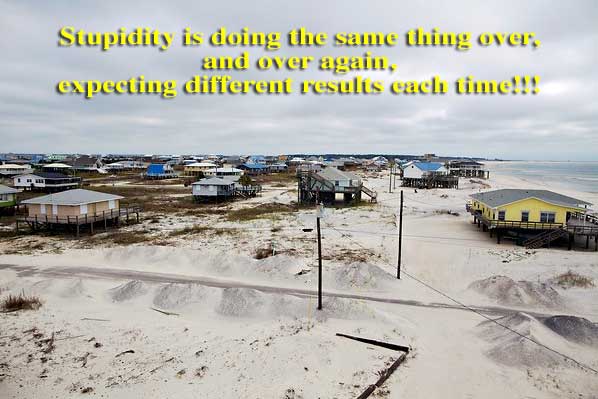
DAUPHIN ISLAND, Ala. — Even in the off season, the pastel beach houses lining a skinny strip of sand here are a testament to the good life.
They are also a monument to the generosity of the federal government.
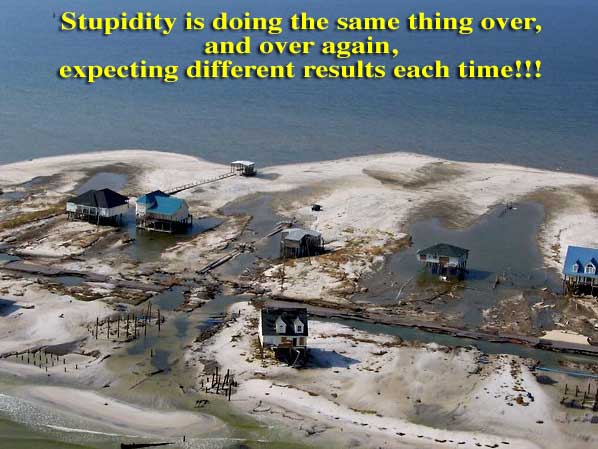
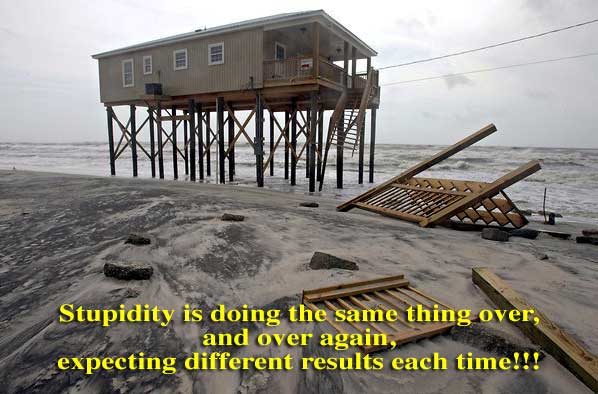
The western end of this Gulf Coast island has proved to be one of the most hazardous places in the country for waterfront property. Since 1979, nearly a dozen hurricanes and large storms have rolled in and knocked down houses, chewed up sewers and water pipes and hurled sand onto the roads.
Yet time and again, checks from Washington have allowed the town to put itself back together.
Across the nation, tens of billions of tax dollars have been spent on subsidizing coastal reconstruction in the aftermath of storms, usually with little consideration of whether it actually makes sense to keep rebuilding in disaster-prone areas. If history is any guide, a large fraction of the federal money allotted to New York, New Jersey and other states recovering from Hurricane Sandy — an amount that could exceed $30 billion — will be used the same way.
Tax money will go toward putting things back as they were, essentially duplicating the vulnerability that existed before the hurricane.
“We’re Americans, damn it,” said Robert S. Young, a North Carolina geologist who has studied the way communities like Dauphin Island respond to storms. “Retreat is a dirty word.”
This island community of roughly 1,300 year-round residents has become a symbol of that reflexive policy.
Like many other beachfront towns, Dauphin Island has benefited from the Stafford Act, a federal law that taps the United States Treasury for 75 percent or more of the cost of fixing storm-damaged infrastructure, like roads and utilities.
At least $80 million, adjusted for inflation, has gone into patching up this one island since 1979 — more than $60,000 for every permanent resident. That does not include payments of $72 million to homeowners from the highly subsidized federal flood insurance program.
Lately, scientists, budget-conscious lawmakers and advocacy groups across the political spectrum have argued that these subsidies waste money, put lives at risk and make no sense in an era of changing climate and rising seas.
Some of them contend that reconstruction money should be tightly coupled with requirements that coastal communities begin reducing their vulnerability in the short run and that towns along shorelines facing the largest risks make plans for withdrawal over the long term.
“The best thing that could possibly come out of Sandy is if the political establishment was willing to say, ‘Let’s have a conversation about how we do this differently the next time,’ ” said Dr. Young, a coastal geologist who directs the Program for the Study of Developed Shorelines at Western Carolina University. “We need to identify those areas — in advance — that it no longer makes sense to rebuild.”
A coalition in Washington called SmarterSafer.org, made up of environmentalists, libertarians and budget watchdogs, contends that the subsidies have essentially become a destructive, unaffordable entitlement.
“We simply can’t go on subsidizing enormous numbers of people to live in areas that are prone to huge natural disasters,” said Eli Lehrer, the president of the conservative R Street Institute, part of the coalition.
This argument might be gaining some traction. Earlier this year, Congress passed changes to the federal flood insurance program that are supposed to raise historically low premiums and reduce homeowner incentives for rebuilding in the most hazardous areas.
Less widely known about than flood insurance are the subsidies from the Stafford Act, the federal law governing the response to emergencies like hurricanes, wildfires and tornadoes. It kicks in when the president declares a federal disaster that exceeds the response capacity of state and local governments.
Experts say the law is at least as important as the flood program in motivating reconstruction after storms. In the same way flood insurance shields families from the financial consequences of rebuilding in risky areas, the Stafford Act shields local and state governments from the full implications of their decisions on land use.
Under the law, the federal government committed more than $80 billion to disaster recovery from 2004 to 2011, according to a report from the Government Accountability Office. While billions of dollars went to relieve immediate suffering, including cash payments to families left homeless by storms, nearly half of the money was spent helping state and local governments clean and restore damaged areas and rebuild infrastructure.
At times, local governments have tried to use the money to reduce their vulnerability to future disasters, but they complain that they often run into bureaucratic roadblocks with the Federal Emergency Management Agency.
For instance, after flooding from Hurricane Irene washed out many culverts in Vermont last year, many towns built bigger culverts to handle future floods. But they are still fighting with the agency over reimbursement.
W. Craig Fugate, the agency’s administrator, acknowledged in an interview that “as a nation, we have not yet figured out” how to use federal incentives to improve resiliency and discourage excessive risks.
If private property owners want to assume the risks, “that’s one thing,” he said. “But if we find that we as taxpayers are assuming that risk without benefit, then we need to rethink that.”
Dauphin Island is a case study in the way the federal subsidies have enabled repetitive risk taking. Orrin H. Pilkey, an emeritus professor at Duke University who is renowned for his research in costal zones, described the situation here as a “scandal.”
The island, four miles off the Alabama coast, was for centuries the site of a small fishing and farming village reachable only by boat. But in the 1950s, the Chamber of Commerce in nearby Mobile decided to link it to the mainland by bridge and sell lots for vacation homes.
Then Hurricane Frederic struck in 1979, ravaging the island and destroying the bridge.
President Jimmy Carter flew over to inspect the damage. Rex Rainer, the Alabama highway director at the time, recalled several years later that the president “told us to build everything back just like it was and send him the bill.”
The era of taxpayer largess toward Dauphin Island had begun. With $33 million of federal money, local leaders built a fancier, higher bridge that encouraged more development in the 1980s. Much of that construction occurred on the island’s western end, a long, narrow sand bar sitting only a few feet above the Gulf of Mexico.
“You can always look back and say, ‘Maybe we shouldn’t have done that,’ ” said Mayor Jeff Collier, who noted that many of the decisions were made before he took office over a decade ago. “But we can’t turn the clock back.”
In the 1990s, big storms started hitting the island roughly every three years. Two back-to-back hurricanes, Ivan in 2004 and Katrina in 2005, destroyed more than 300 homes. Most have not been rebuilt, but scores have been. Some beachfront building lots are now inundated by the Gulf of Mexico.
The bulk of the town’s reconstruction money has been spent on the western end. That means many of the prime beneficiaries have not been permanent residents, but rather vacation homeowners from places like New Orleans and Atlanta.
Since 1988, federal figures show, Dauphin Island property owners have paid only $9.3 million in premiums to the national flood insurance program, but they have received $72.2 million in payments for their damaged homes. Figures from a federal contractor show that the average island resident pays less than $700 a year for flood insurance, though a few do pay as much as $3,000.
On Dauphin Island and in many other beachfront communities, the federal subsidies have helped people replace small beach shacks with larger, more valuable homes. That is a main reason the nation’s costs of storm recovery are roughly doubling every decade, even after adjusting for inflation.
Dauphin Island has tried to limit its risk, imposing stricter building codes that go beyond federal requirements. New houses now must be built high on pilings to survive storm surges.
Local residents argue that federal help is warranted because their erosion problems have been worsened by government dredging in the nearby Mobile Ship Channel, which some scientists agree has helped starve the Dauphin Island beaches of sand. And residents say that simply letting the island’s western end wash away would leave the mainland and its marshes, rich with seafood, more exposed to storms.
People here have formed strong emotional attachments to their island. “There’s a lot of wildlife and a lot of bird life, and it’s just a great place to relax,” said Jay Minus, a lawyer in Mobile who owns two homes on the western end. “You can sit on the porch and watch the dolphins swim past your house.”
Just this summer, Hurricane Isaac dealt the island a moderate blow, leaving most homes unscathed but managing to do $3 million worth of damage to public infrastructure. On a recent day, bulldozers crawled around the island, scooping up tons of sand to replenish the beach. As in the past, the town will most likely pay only 15 percent of the repair costs.
Coastal geologists describe western Dauphin Island as a textbook example of a place that should never have been developed. Scientists say that climate change will most likely speed up the rise of sea levels in the coming decades and that many more coastal communities will face repetitive risks.
With little pressure coming from Washington or state governments, only a handful of communities have started thinking seriously about a new approach.
“We need a plan,” Dr. Young said.
Given the political realities, however, it is by no means clear how to move forward. In some flood plains, public money has been used to buy out vulnerable property owners. Entire towns were moved out of the Mississippi River flood plain in the 1990s, for instance, saving money over the long haul.
Several oceanfront communities have resisted such proposals, though one, in Texas, consented to a buyout plan after being badly damaged by Hurricane Ike in 2008. The federal government, despite its willingness to spend tens of billions of dollars repairing communities after storms, has not put up the kind of buyout money that might convince more owners to walk away.
Because buyout proposals often take years to put together, several experts suggested that they be drawn up in advance with maps of properties targeted for acquisition. Then, if those homes are damaged, state or local leaders could move swiftly after a storm, offering the owners voluntary buyouts before they make up their minds to rebuild.
Mr. Collier, the mayor, has long heard the argument that a rising sea will ultimately force a retreat from Dauphin Island and similar places.
“I’m not going to say that’s wrong,” he said. “But somebody needs to tell me, how are we going to get there?”

F.D.A. Posts Injury and Fatality Data for 3 Energy Drinks
- By BARRY MEIER - The New York Times - November 15, 2012
As its policy on highly caffeinated energy drinks is scrutinized, the Food and Drug Administration publicly released records on Thursday about fatality and injury filings that mentioned the possible involvement of three top-selling products.
 The Web posting of the records by the agency included 13 previously undisclosed injury filings that mentioned Rockstar Energy. The F.D.A. also released filings related to 5-Hour Energy, a popular energy shot, and Monster Energy, another popular brand.
The agency’s action comes a day after The New York Times reported that the agency had received more than 90 filings about 5-Hour Energy, including reports that cited its possible involvement in 13 fatalities. In late October, the F.D.A. confirmed that it had received five fatality reports that cited Monster Energy.
The filing of an incident report with the F.D.A. does not mean that a product was responsible for a death or an injury or contributed to it in any way. The makers of 5-Hour Energy and Monster Energy have insisted their products are safe and unrelated to the problems reported to the F.D.A.
Officials of Rockstar Energy Drink, which is based in Las Vegas, did not return calls on Thursday seeking comment
The release of the filings may represent a turnabout in agency policy. While units within the F.D.A. that oversee prescription drugs and medical devices make so-called adverse event reports about those products available to the public through Web sites or other means, the unit that oversees dietary supplements routinely does not do so.
Shelly Burgess, an agency spokeswoman, said the agency had decided to release the records “in an effort to be transparent.” She added that the filing of a report did not show a product was at fault.
“If we find a relationship between consumption of the product and harm, F.D.A. will take appropriate action to reduce or eliminate the risk,” Ms. Burgess said.
Meanwhile, two senators, Richard Durbin of Illinois and Richard Blumenthal of Connecticut, sent a letter on Thursday to the F.D.A. commissioner, Dr. Margaret A. Hamburg, seeking a meeting to discuss energy drinks. Mr. Durbin and Mr. Blumenthal are Democrats.
Both lawmakers have pressed the agency to tighten regulations of energy drinks, but it has said that it has not yet seen sufficient evidence to do so.
“There has been alarming evidence that energy drinks pose a potential threat to the public’s health,” the two senators wrote.
Many medical experts say healthy adults can safely consume 400 milligrams or more of caffeine daily, or about as much caffeine as in several 8-ounce cups of coffee or in two 16-ounce cans of many energy drinks.
There is scant data, however, about whether such levels are safe for young teenagers to whom energy drinks are frequently marketed. Along with caffeine, energy drinks typically contain other ingredients like high levels of certain B vitamins and a substance called taurine, which exists inside the body.
The records released on Thursday by the F.D.A. cover a period from 2004 to last month. But the vast majority of filings are from the last four years; beginning in late 2008, makers of dietary supplements were required to notify the F.D.A. of a report of a fatality or injury that might have been associated with their products.
The three products involved in the release — Rockstar Energy, 5-Hour Energy and Monster Energy — are all marketed as dietary supplements. Other energy drinks like Red Bull, NOS and AMP are marketed by their producers as beverages. There is not a mandatory reporting requirement for beverages, though makers can do so voluntarily.
In releasing the filings, the F.D.A. said it thought that even with the mandatory reporting requirement for dietary supplements, “only a small fraction of adverse events associated with any product is reported.”
Last year, the F.D.A. received about 2,000 such reports about dietary supplements and weight-loss products, two broad categories that include more than 50,000 products.
Officials of the F.D.A. dietary supplement unit have said they were working on ways to make reports of adverse events public, but they have not set a timetable to do so. The records related to Monster Energy and 5-hour Energy came to light because they were released by the F.D.A. under the Freedom of Information Act.
Over all, sales of energy drinks in the United States grew an estimated 16 percent last year to $8.9 billion, a record level, according to Beverage Digest, a trade publication.
A report last year by the federal Substance Abuse and Mental Health Services Administration found that the annual number of emergency room visits in this country linked to energy drinks rose to more than 12,000 in 2009, the latest year for which data was available. The figure represents a tenfold jump from the number of such visits reported in 2005.
Hurricane Sandy - A Fierce and Devastating Wake-up Call
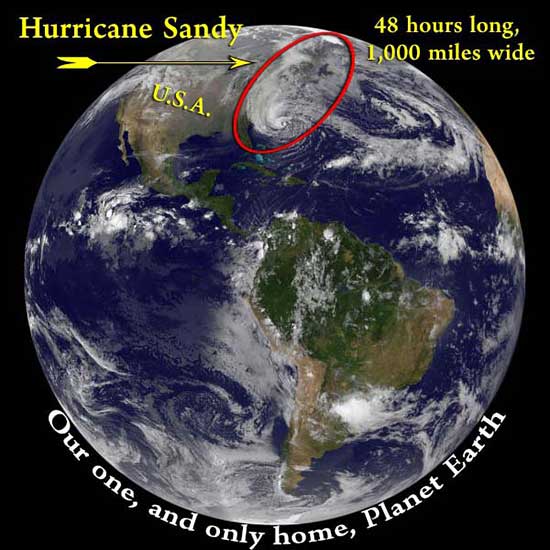
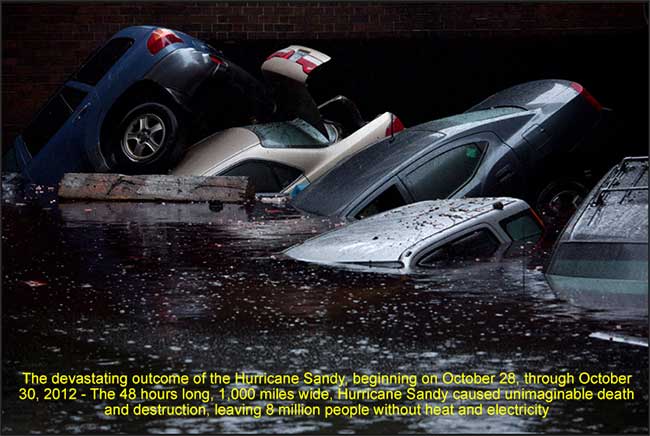
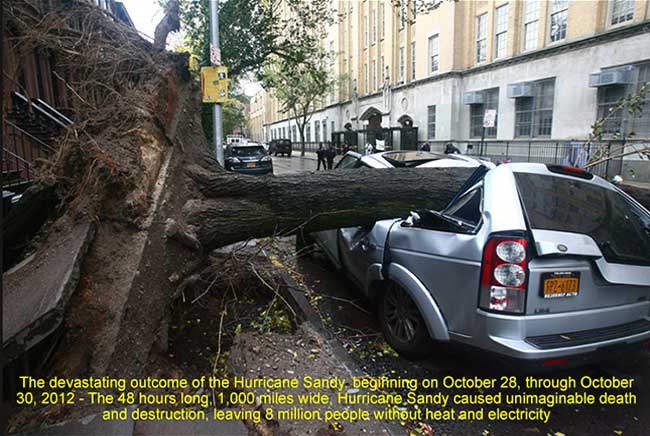
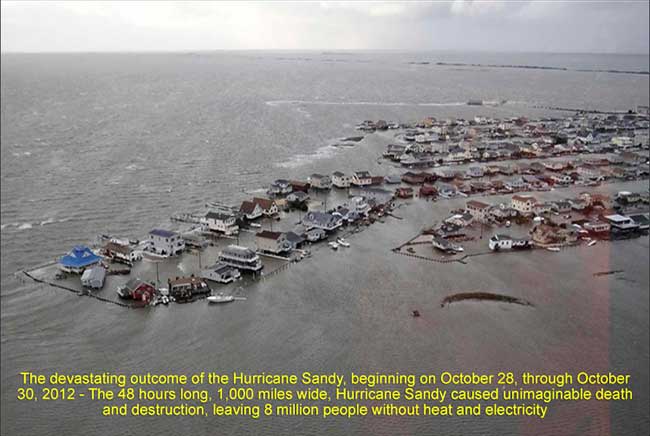
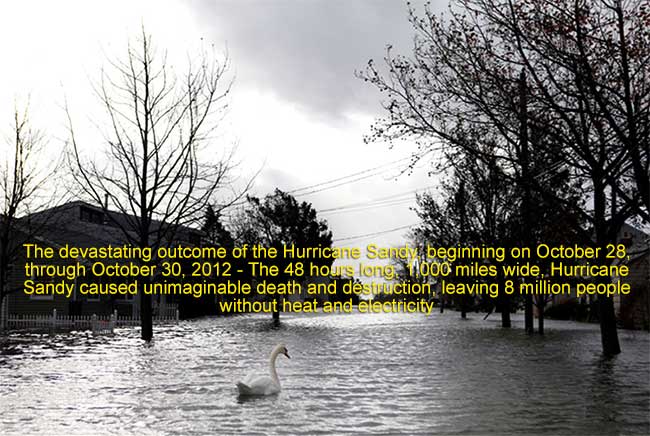
The devastating outcome of the Hurricane Sandy, beginning on October 28, through October 30, 2012 - The 48 hours long, 1,000 miles wide, Hurricane Sandy caused unimaginable death and destruction, leaving 8 million people without heat and electricity.
Hurricane Sandy is just the beginning of more intense and devastating climactic changes to come. - But it doesn’t have to be this way. - We, the humanity have many other viable choices of safe, environmentally friendly and sustainable means of generating our own power utilizing New Energy.
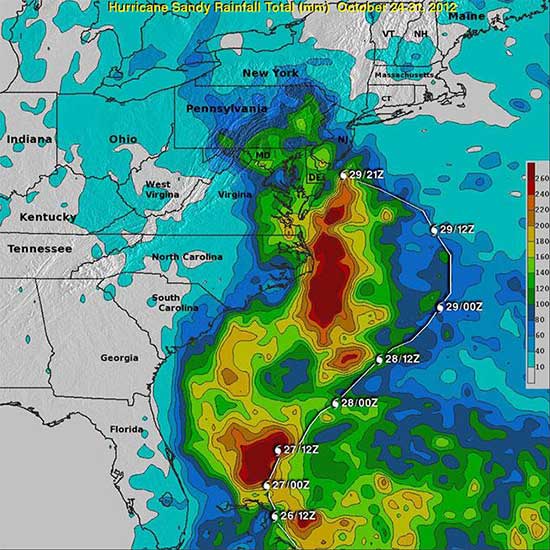
Hurricane Sandy - A Far-Reaching System That Leaves 8 Million Without Power
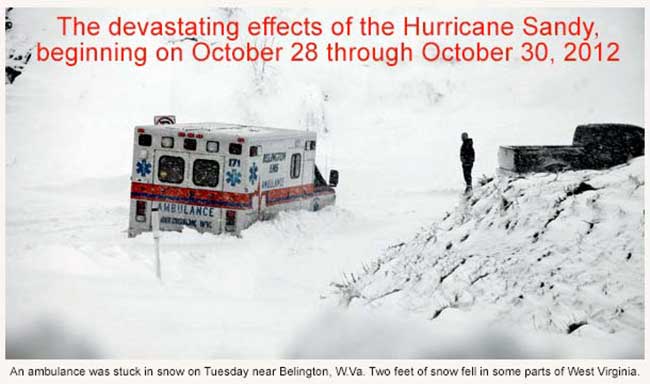
- By JOHN SCHWARTZ - The New York Times - October 30, 2012
SCRANTON, Pa. — The reach of the storm called Sandy was staggering, with devastation along the coasts, snow in Appalachia, power failures in Maine and high winds at the Great Lakes.
In West Virginia, two feet of snow fell in Terra Alta, where Carrie Luckel said she had to take drastic measures to stay warm. “We are seriously using a turkey fryer to keep our bedroom warm enough to live and a Coleman stove in our bedroom to heat up cans of soup,” Ms. Luckel said. “Our milk is sitting on the roof.”
Along the shores of Lake Michigan in Chicago, gawkers who had come to see the crash of 20-foot waves were struggling against gusts that the National Weather Service said could reach 60 miles per hour. “It’s hard to even stand there and look,” said Mike Magic, 36.
The storm was very unlike last year’s deluging Hurricane Irene, which caused severe flooding across many states. The relative lack of rain and the weakening of the storm as it progresses means that the worst damage — and the historic significance — of this storm will be its battering effect on the East Coast, said Brian McNoldy, a hurricane expert at the University of Miami. “Irene will be remembered only for its rain, and Sandy will be remembered only for its surge,” he said.
While the storm has weakened as it moved inland, its winds downed trees and caused some eight million utility customers to lose power. Coastal flooding hit Rhode Island and Massachusetts, and the storm left local flooding in its wake across Delaware, Virginia, Maryland and Pennsylvania. In Maryland, the sewage treatment plant for Howard County lost power, and about two million gallons of water and untreated sewage poured into the Patuxent River hourly. Still, Gov. Martin O’Malley said the state was “very, very fortunate to be on the kinder end of this very violent storm.”
Forecasters said on Tuesday that they no longer expected the storm to turn to the northeast and travel across New England. Instead, the track shifted well to the west, and prediction models suggested a path through central Pennsylvania and western New York State before entering southern Ontario by Wednesday, said Eric Blake, a hurricane specialist with the National Hurricane Center in Miami.
In Scranton, residents enjoyed the relief that comes whenever bullets have been dodged.
“People around here are very concerned about flooding after Irene last year — many people are just recovering,” said Simon Hewson, the general manager at Kildare’s Irish Pub. He prepared the establishment for a severe storm, then “just hunkered down and waited,” said Mr. Hewson, who hails from Dublin. He came in the next morning to an undamaged pub: “We got lucky.”
Experience with natural disaster in an environment that climate change has made increasingly unpredictable has taught strong lessons to many of those who have to deal with storms. Amy Shuler Goodwin, director of communications for the office of Gov. Earl Ray Tomblin of West Virginia, said “without question we are better prepared this time around than last time,” referring to the freakishly powerful “derecho” line of storms that slammed across 700 miles of the Midwest and the mid-Atlantic in July.
As the storm continues to move inland and loses contact with the ocean — its source of moisture — rain levels are expected to diminish, though wind damage is still likely.
When it comes time to assess the damage and help clean up the mess caused by the storm, the Army Corps of Engineers will have plenty of work on its hands, said Col. Kent D. Savre, the commander and division engineer for the corps’ North Atlantic division, whose operations stretch from Virginia to Maine; he expects help from corps districts across the nation: “They kind of come to the sound of the guns when there’s an event like this.”
For some, the storm brought wonder. At LeConte Lodge in the Great Smoky Mountains National Park, a hike-in set of cabins at 6,600 feet, about 25 visitors huddled around a fire while snow piled up in drifts of up to five feet, said Allyson Virden, who runs the lodge. The 22-inch snowfall is already eleven times greater than the average for October, but Ms. Virden tried looking on the bright side. “We don’t have power to lose up here,” she said. “And it’s gorgeous.”
Reporting was contributed by Brian Stelter from Delaware, Theo Emery from Maryland, John H. Cushman Jr. from Washington, Timothy Williams from New York, Katharine Q. Seelye from Boston, Kim Severson from Atlanta, Steven Yaccino from Chicago and Cynthia McCloud from Terra Alta, W.Va.
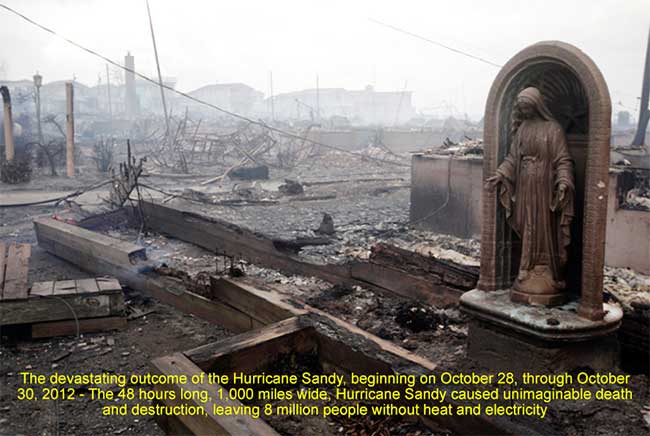
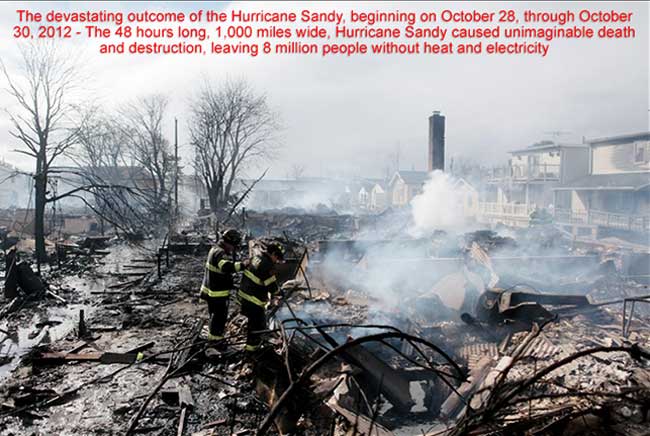
Problems at Five Nuclear Plants - Hurricane Sandy 30 Oct 2012 The nation's oldest nuclear plant declared an alert and a second plant just 40 miles from New York City was forced to shut down power as five different nuke plants in Hurricane Sandy's path experienced problems during the storm. Indian Point in Buchanan, New York, on the Hudson River north of New York City, automatically shut power to its unit 3 on Monday night "as a result of an electrical grid disturbance," according to Entergy, the plant's operator... Operators also declared an alert at the nation's oldest nuclear plant, Oyster Creek in Lacey Township, New Jersey, on Monday evening after the center of Sandy made landfall, "due to water exceeding certain high water level criteria in the plant's water intake structure." The plant also lost power, which is critical to keep spent fuel rods from overheating, but "the station's two backup diesel generators activated immediately," Exelon said.
NJ nuclear plant on alert as state struggles to cope with Sandy's surge 30 Oct 2012 America’s oldest nuclear power plant is on alert after waters from a colossal storm reached high levels. Oyster Creek in Lacey Township, New Jersey, was already offline for regular maintenance before Sandy, a superstorm downgraded Monday night from a hurricane, slammed the East Coast. The Nuclear Regulatory Commission says an "unusual event" was declared around 7 p.m. when water reached a high level. The situation was upgraded less than two hours later to an "alert," the second-lowest in a four-tiered warning system.
Japan-Style Nuclear Safety Errors Abound, Regulator Warns 30 Oct 2012 Japan's nuclear safety failures that led to last year's disaster at Fukushima are being repeated in other countries that operate atomic reactors, according to France's top regulator. Nuclear safety focuses too much on technology and not enough on the human side of preventing accidents, Andre-Claude Lacoste, 70, the outgoing head of the French Autorite de Surete Nucleaire, said in an interview. Regulators in some countries, which he declined to name, lack enough independence from industry and government to be able to identify nuclear safety shortfalls, Lacoste said.
Sandy's mammoth wake: 46 dead, millions without power, transit --Storm's impact to widen as it disperses north to Canada, south to Tennessee 31 Oct 2012 The sweep of devastation from Superstorm Sandy became heartbreakingly clear Tuesday: At least 46 people are dead, and authorities face the unimaginable task of restoring power and transit for millions of others. "We have not seen damage like this in a generation," New York Gov. Andrew Cuomo, assessing the scope of a hurricane that swept homes into the ocean, flooded large swaths of coastal areas, left millions of people without power and crippled transportation, told NBC News.
First an electricity blackout and now CELL PHONE coverage is down as users in Manhattan battle signal failures --Many people are virtually cut off and have no way of calling for help if there are further emergencies 30 Oct 2012 Thousands of people in Manhattan woke to find they had no cell phone coverage this morning after Superstorm Sandy battered the city's phone masts. Cell phone users in large swathes of Lower Manhattan suffered the signal failures after 24 hours of devastating weather. For many it means they are virtually cut off and have no way of contacting friends or family or calling for help if there are further emergencies.
Transformer explosion at 14th St Con Edison building 30 Oct 2012 A transformer reportedly exploded last night as Hurricane Sandy slammed the city, shortly before power was lost throughout much of lower Manhattan. A power failure struck the Con Edison command center near Union Square around 8pm, according to the Wall Street Journal, following a substation failure that is reportedly responsible for loss of power in Greenwich Village and Lower Manhattan. Con Ed had preemptively cut power to residents south of the Brooklyn Bridge in Manhattan to protect underground equipment from water damage, in a move described as unprecedented.
- You are here:
-
Home

- News